Tarasha Dental Clinic: Best Dental Services in Lajpat Nagar

- Home
- About
-
Treatments
CosmeticImplants & Restorative
- Our Doctors
- Blogs
- Gallery
- Contact
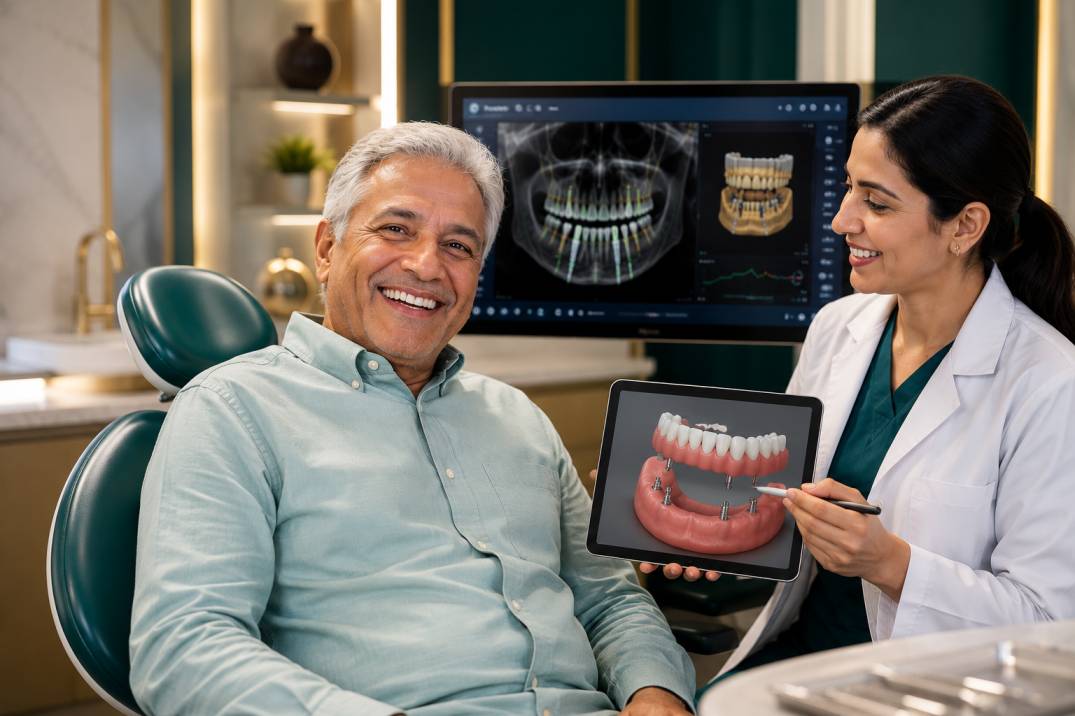
Implant-Supported Overdentures in South Delhi —
A More Secure Alternative to Traditional Dentures
Loose dentures that shift while eating, affect your speech, or limit your confidence are a solvable problem. Implant-supported overdentures anchor your denture firmly to the jaw — delivering dramatically better stability, comfort, and daily function, at a more accessible entry point than full fixed implants.
What Are Implant-Supported Overdentures?
Implant-supported overdentures — also called implant-retained dentures or secure dentures — are a type of removable prosthetic that attaches to dental implants placed in the jaw, rather than resting on the gum tissue alone as conventional dentures do. The implants act as anchoring points that hold the denture securely in position during eating and speaking, while still allowing the denture to be removed for cleaning.
This approach sits between conventional complete dentures and fully fixed full mouth dental implants in terms of complexity, cost, and stability. For patients who want a meaningful improvement over loose dentures without committing to a fully fixed arch, implant-supported overdentures represent an excellent clinical and financial balance.
At Tarasha Dental Clinic, implant-supported overdentures in South Delhi are designed and placed by Dr. Niraj (MDS, AIIMS Alumni — Prosthodontics & Implantology), using digital 3D planning and internationally proven implant systems. The overdenture itself is precision-fabricated to fit the implant attachment system for a reliable snap-in connection with every use.
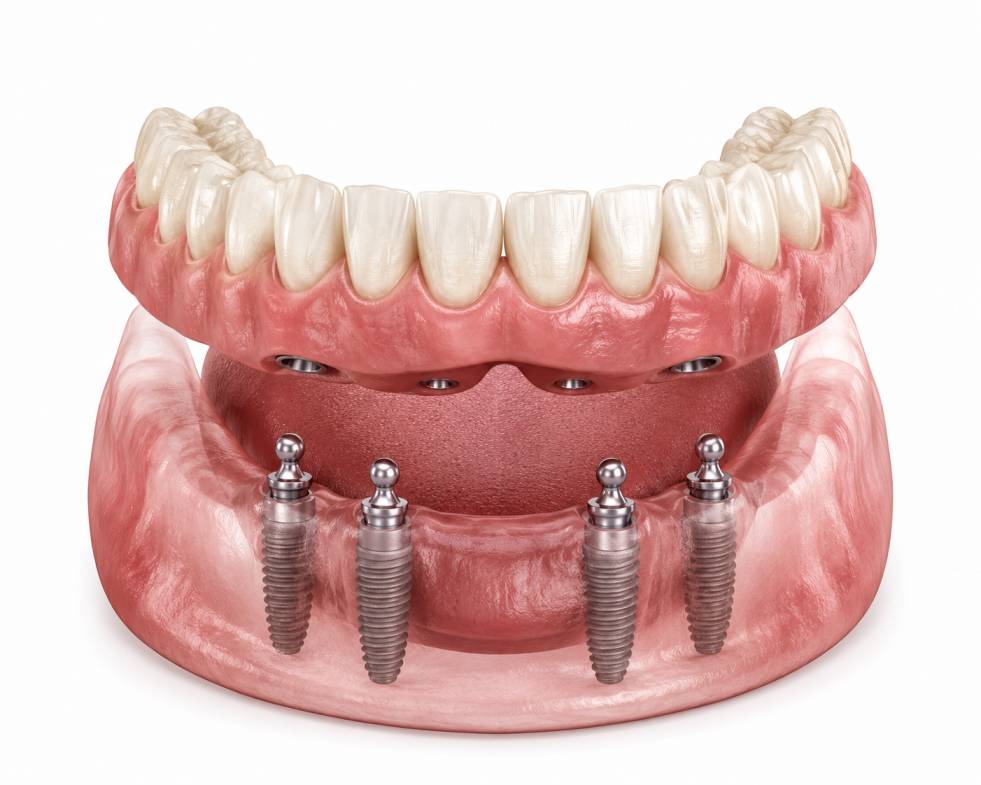
- Implants needed: 2–4 per arch (jaw)
- Removable: Yes — for easy cleaning
- Healing period: 2–4 months after placement
- Overdenture life: 5–10+ years
- Implant life: 15–25+ years with care
How Implant-Supported
Overdentures Work
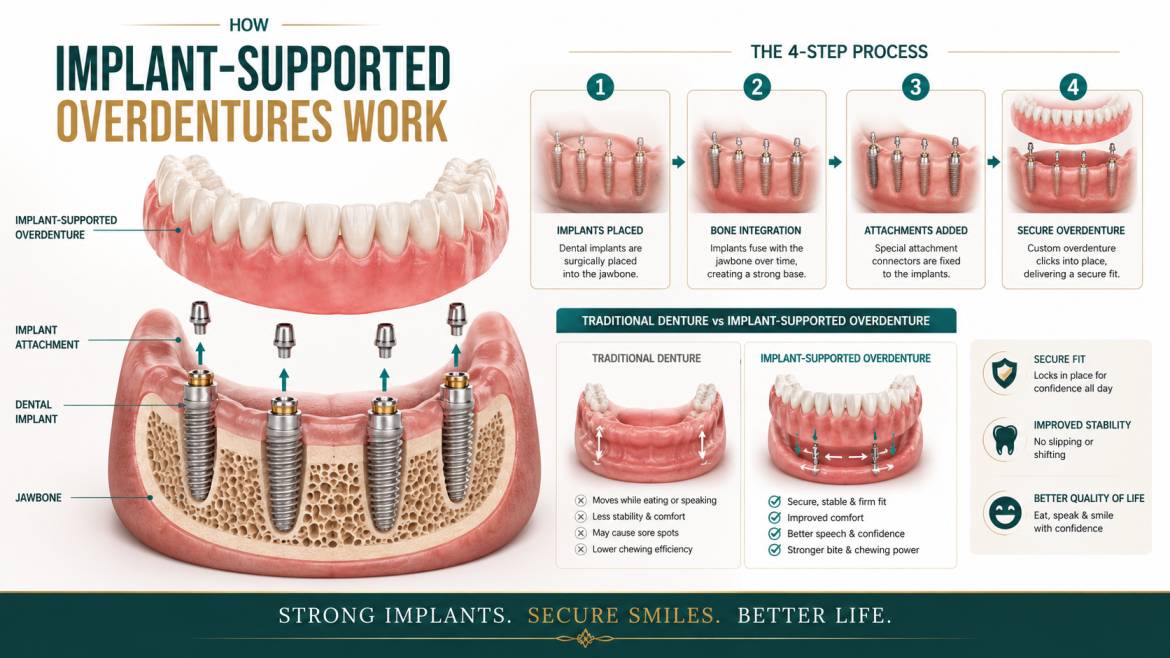
The principle is straightforward: titanium implants placed in the jawbone act as anchoring posts, and the overdenture connects to these posts via a precision attachment system. The result is a denture that stays where it is supposed to stay.
Dental Implants as Anchors
Typically 2–4 titanium implants are placed in the jawbone. These integrate with the bone over 2–4 months (osseointegration) — becoming as stable as natural tooth roots. Even 2 implants create a transformative improvement in denture stability over conventional dentures.
Attachment Systems
Two main attachment designs are used. Ball attachments use a ball-and-socket mechanism on each implant — the denture snaps onto each ball for a firm hold that releases easily for removal. Bar attachments connect all implants with a custom metal bar, and the denture clips onto the bar for even greater stability across the full arch.
Long-Term Oral Health Benefits
Unlike conventional dentures, implant-supported overdentures stimulate the jawbone through the implant posts — slowing the bone resorption that accelerates facial ageing after tooth loss. This is a clinically significant benefit that conventional dentures cannot provide.
Who Is a Candidate for
Implant-Supported Overdentures?
Implant-supported overdentures suit a wide range of patients — particularly those who are dissatisfied with conventional dentures or are seeking an effective, more affordable alternative to fully fixed implant bridges.
Complete Tooth Loss
Patients who have lost all teeth in one or both jaws and are seeking the most stable removable solution available — without committing to a fully fixed implant bridge.
Loose Traditional Dentures
Existing denture wearers experiencing movement, slipping, or instability during eating and speaking — who want a reliable, permanent solution to retention problems.
Difficulty Eating
Patients who have significantly restricted their diet because loose or poorly fitting dentures cannot handle the forces of normal chewing. Implant retention transforms what is possible at mealtimes.
Denture Movement While Speaking
Dentures that shift or click during conversation affect both intelligibility and confidence. Implant retention eliminates this completely — speech becomes natural and unselfconscious again.
Reduced Confidence
Patients who avoid social situations, avoid laughing openly, or feel constantly anxious about their denture moving — for whom a securely anchored denture would represent a fundamental quality-of-life change.
Not Ready for Full Fixed Implants
Patients who want improved stability but prefer a removable solution for easier cleaning, or for whom fully fixed implant bridges are not indicated due to bone volume, cost, or personal preference.
“For patients who have lived with loose dentures for years, implant-supported overdentures are one of the most impactful treatments we provide. The change in daily quality of life is immediate and profound.”
— Dr. Niraj, MDS · AIIMS Alumni · Prosthodontics & ImplantologyBenefits of Implant-Supported Overdentures
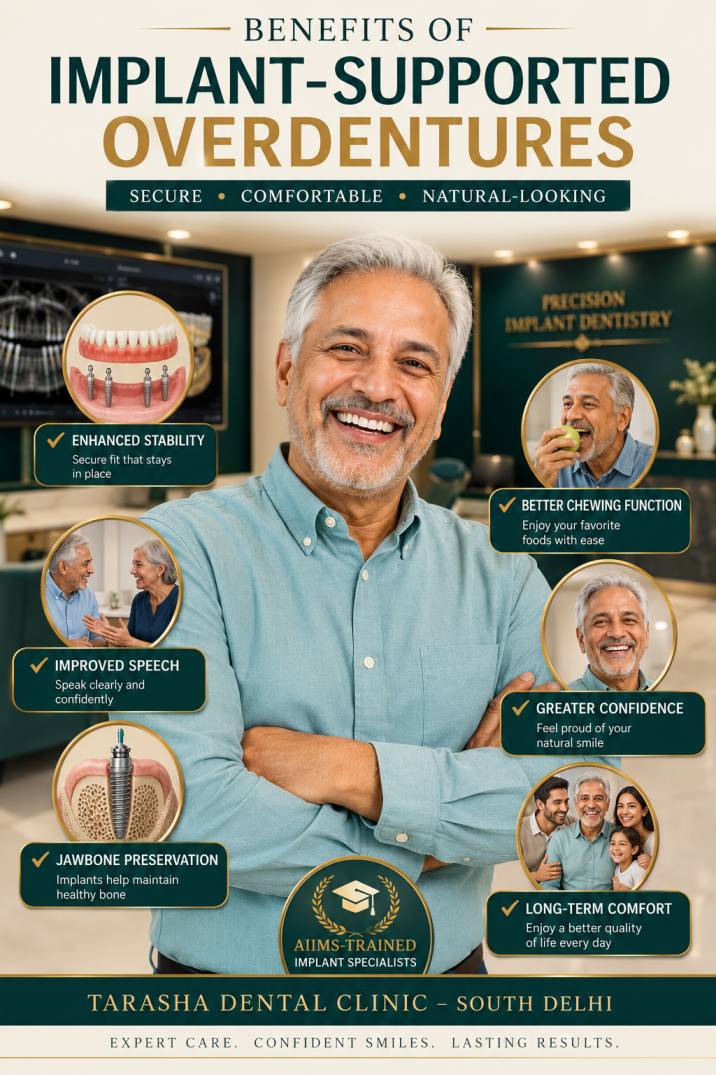
- 01
Greater Denture Stability
The most immediate and obvious benefit. Implant anchoring eliminates the movement, rocking, and slipping that define the conventional denture experience. The denture stays fixed during eating and speaking.
- 02
Improved Chewing Efficiency
With firm implant retention, patients can chew with significantly more force and confidence — returning to foods they had been avoiding and eating meals without anxiety or restriction.
- 03
Better Speech
Fixed retention eliminates the clicking, slurring, and movement that make speaking with conventional dentures self-conscious. Normal speech patterns are fully restored.
- 04
Enhanced Comfort
Implant-supported overdentures distribute forces through the implants and into the bone — rather than pressing on sensitive gum tissue. Gum soreness and pressure points are dramatically reduced.
- 05
Jawbone Preservation
The implant posts stimulate the jawbone, reducing the bone resorption that causes the facial collapse characteristic of long-term conventional denture wear. This is a significant long-term health benefit.
- 06
Better Quality of Life
Freedom from denture adhesives, confidence at social meals, ability to laugh without covering the mouth — the overall quality-of-life improvement is consistently the outcome patients describe as most significant.
Understanding Your Options —
Three-Way Comparison
The choice between conventional dentures, implant-supported overdentures, and full mouth fixed implants depends on your clinical situation, priorities, and budget. Here is an honest comparison across all three.
| Feature | Traditional Dentures | Implant Overdentures | Full Mouth Implants |
|---|---|---|---|
| Stability | Low — rests on gums only | High — snapped onto implants | Highest — fully fixed |
| Removable | Yes | Yes — easy to clean | No — brushed in place |
| Chewing Force | ~25% of natural | ~50–60% of natural | ~70–90% of natural |
| Bone Preservation | No | Partial — via implants | Full — all implant roots |
| Implants Required | None | 2–4 per arch | 4–6+ per arch |
| Adhesives Needed | Often yes | Never | Never |
| Cleaning | Removed, soaked daily | Removed for cleaning | Brushed like natural teeth |
| Gum Comfort | Pressure & soreness common | Forces through implants | No gum pressure |
| Treatment Cost | Lowest | Moderate | Highest |
| Treatment Complexity | Lowest | Moderate | Highest |
| Best For | Budget-limited patients | Stability without full commitment | Maximum function & longevity |
Implant-supported overdentures are an excellent choice when you want significantly better stability and quality of life than conventional dentures can offer, without the higher implant count and cost of a fully fixed arch. For patients with lower bone volume, limited budget, or preference for a removable solution, they are often the ideal recommendation. Book a consultation at Tarasha — your specialist will help you identify the right option clearly and without pressure ↗
The Implant-Supported Overdenture Process
at Tarasha Dental Clinic
Your overdenture journey at Tarasha is carefully planned, digitally guided, and designed to be as comfortable and predictable as possible. Here is what to expect from your first appointment to your first full meal with your new smile.
Consultation & Assessment
A comprehensive review of your dental and medical history, current denture situation, and aesthetic goals. Your specialist examines gum health, remaining bone volume, and overall suitability — and discusses all available options honestly.
Digital 3D Imaging
Cone Beam CT (CBCT) imaging maps your jaw bone in three dimensions — assessing volume, density, and nerve locations. This is the foundation of safe, precise implant placement planning and is reviewed in detail with you before any commitment.
Implant Placement
Under local anaesthesia, 2–4 implants are placed in the jawbone using digital planning guidance. The procedure is well-tolerated by most patients. Healing caps are placed and you wear your existing denture (adjusted) during the healing phase.
Healing Phase
The implants integrate with the jawbone over 2–4 months. This osseointegration phase is monitored with review appointments. Once integration is confirmed, the overdenture fabrication process begins.
Overdenture Fabrication
Digital scans and clinical records are used to fabricate your custom overdenture — with the attachment housings precisely positioned to engage the implant abutments. The prosthetic teeth are selected and arranged to match your facial proportions and aesthetic preferences.
Final Fitting & Follow-Up
Your overdenture is fitted, the snap-in connection verified, bite adjusted, and you are guided through removal, cleaning, and reinsertion. Follow-up appointments ensure the fit remains optimal and the implants are healthy long-term.
Why Patients Choose Tarasha Dental Clinic for
Implant-Supported Overdentures in South Delhi
Implant overdenture outcomes depend heavily on clinical judgment, digital planning quality, and the precision of the prosthetic fit. Tarasha brings the highest available standard across every stage of this process.
AIIMS Alumni Implantologist
Dr. Niraj (MDS, AIIMS Alumni — Prosthodontics) leads all overdenture implant cases with the clinical depth and evidence-based precision that AIIMS post-graduate training produces.
CBCT 3D Digital Planning
Every implant is planned in 3D before surgery — bone volume, density, and anatomy mapped precisely so each implant goes exactly where it needs to go for maximum long-term stability.
All Options Available
Ball attachment, bar-retained, and hybrid overdenture designs — all available at Tarasha. The right design for your bone anatomy and lifestyle, not the one the clinic happens to offer.
Ethical Consultations
Implant overdentures are recommended when they are clinically the right option. No upselling to fixed implants when overdentures are appropriate. No minimising when fixed implants would serve you better.
International Sterilisation
Class B autoclaves, WHO-compliant surgical protocols, sterile field maintenance — the surgical safety standards that implant procedures demand, maintained unconditionally at Tarasha.
International Patient Support
Online pre-travel consultations, digital records for home dentists, efficient scheduling for NRI and overseas patients. Tarasha has significant experience managing overdenture cases for international patients.
Premium Patient Experience
Unhurried appointments, clear communication at every stage, and a team that understands that implant surgery feels significant — and treats it accordingly.
South Delhi Location
Lajpat Nagar I — easily accessible from across South Delhi, near Lajpat Nagar and Moolchand Metro stations. Convenient for multiple implant and prosthetic appointments.
Implant Overdentures for
International Patients
For NRIs and international patients visiting Delhi, implant-supported overdentures in India represent exceptional value — with savings of 60–80% compared to equivalent treatment in the USA, UK, Canada, or Australia, delivered to the same clinical standard by an AIIMS-trained specialist.
Online Consultation Before Travel
Share existing scans, X-rays, and photographs via WhatsApp (+91 96259 52590). Receive an initial assessment and provisional plan before arriving in Delhi.
Implant Placement on Visit One
Implants placed on your first visit. For suitable cases, a temporary overdenture can be attached at the same appointment.
Healing at Home
Digital records provided. Tarasha team accessible via WhatsApp throughout the healing period. Your home dentist can monitor progress with provided documentation.
Final Overdenture on Visit Two
Return for final overdenture fitting once osseointegration is confirmed — typically 2–4 months after implant placement.
Investment & How Long Results Last
Complete cost transparency is provided at your consultation. Cost varies based on these clinical factors.
- Number of implants — 2-implant vs 4-implant designs have different stability profiles and costs
- Attachment system — ball attachments vs bar-retained overdentures
- Jaw condition — bone grafting may be needed if bone volume is limited
- One or both arches — upper arch, lower arch, or complete upper and lower
- Technology used — CBCT imaging and guided planning are included
On longevity: the titanium implants themselves can last 15–25+ years with proper care. The overdenture prosthetic typically lasts 5–10 years before the attachment mechanisms or the prosthetic base may need replacement or refurbishment — a routine process significantly less involved than the original treatment.
- Clean overdenture daily — remove and brush both the prosthetic and the attachment areas
- 6-monthly professional check-ups — implant health assessment, professional cleaning around abutments
- Avoid smoking — tobacco significantly increases implant failure risk and compromises healing
- Night guard if needed — if grinding is present, a protective night guard protects attachment mechanisms
Overdenture Implant
FAQs
Everything patients ask before choosing implant-supported overdentures — answered clearly and honestly.
“Your specific situation determines the right option. One consultation answers everything.”
Book Your Consultation ↗-
Implant-supported overdentures are a removable prosthetic (denture) that attaches to 2–4 dental implants placed in the jaw, rather than resting on the gum tissue alone as conventional dentures do. The implants act as stable anchor points — the denture snaps or clips onto them, providing dramatically better stability and comfort than conventional dentures, while still allowing the denture to be removed for cleaning. At Tarasha Dental Clinic, they are designed and placed by Dr. Niraj (MDS, AIIMS Alumni) using digital 3D planning.
-
Yes — implant-supported overdentures are removable by design. This is one of the key distinctions from fully fixed full mouth dental implants. The overdenture snaps or clips onto the implant abutments for firm retention during use, but can be easily removed by the patient for cleaning each day. This removability is considered a feature rather than a limitation — it makes cleaning around the implant sites easier and the prosthetic simpler to maintain than a fixed bridge.
-
In all clinically meaningful ways, yes. Implant-supported overdentures provide significantly better stability (no movement during eating or speaking), eliminate the need for denture adhesives, provide partial bone preservation through the implant posts, are more comfortable (forces distributed through implants, not gum tissue), and dramatically improve quality of life and confidence. The only advantage conventional complete dentures retain is lower initial cost. For patients who can receive implants, overdentures represent a transformative improvement.
-
Typically 2–4 implants per arch. A 2-implant lower overdenture is one of the most studied and clinically well-supported procedures in implant dentistry, providing a substantial stability improvement over conventional dentures with the minimum possible implant count. Four implants per arch provide greater stability and are preferred where bone allows. The upper arch generally benefits from more implants (4) because the palate cannot assist with retention the same way it does in a conventional upper denture. Your Tarasha specialist will recommend the ideal number based on your bone volume and arch.
-
Implant placement at Tarasha is performed under local anaesthesia and should not be painful during surgery — patients typically feel pressure but not pain. Post-operative discomfort for 2–5 days is managed well with standard prescribed pain medication and is typically milder than patients anticipate. For anxious patients, sedation options are available. The placement of 2–4 implants for an overdenture is generally a shorter, more straightforward procedure than full arch implant surgery, and most patients find it very manageable.
-
Total treatment duration is typically 3–6 months. Implant placement surgery takes approximately 1–2 hours. The osseointegration (healing) period requires 2–4 months before the overdenture can be finalised. Overdenture fabrication then takes 2–4 weeks. International patients can often have implants placed on a first visit, heal at home, and return for the final overdenture fitting. Cases requiring bone grafting before implant placement will require additional time.
-
Yes — and for international patients, India represents exceptional value for implant overdenture treatment. Typical savings compared to USA, UK, Canada, and Australia are 60–80%, with the same AIIMS-trained specialist expertise and digital planning technology. Tarasha’s workflow for international patients involves an online consultation before travel, implant placement on visit one, healing at home, and final overdenture fitting on a subsequent India visit. Contact Tarasha to begin your pre-travel assessment.
-
Implant overdenture outcomes depend on precise surgical placement, accurate bone assessment, appropriate case selection, and the quality of the prosthetic design. AIIMS post-graduate Prosthodontics and Implantology training is the most rigorous specialist programme in India — producing clinicians with the surgical precision, anatomical knowledge, and prosthetic design expertise that implant dentistry demands. Dr. Niraj (MDS, AIIMS Alumni) at Tarasha brings evidence-based protocols and significant case experience to every overdenture consultation. For a treatment of this significance, the qualification and experience of the specialist is the most important factor in your outcome.
Secure Your Denture.
Reclaim Your Confidence.
Loose dentures are a solvable problem — and the solution does not have to be as complex or expensive as you might imagine. Implant-supported overdentures at Tarasha Dental Clinic give you the stability, comfort, and confidence that conventional dentures simply cannot match, at a more accessible cost than fully fixed implants.
The first step is a consultation. No commitment, no pressure — just an honest assessment of what is possible for your specific situation from an AIIMS-trained specialist.
Tarasha Dental Clinic · An Initiative by AIIMS Alumni
SCO 2&3, D-177, Railway Crossing, Lajpat Nagar I, New Delhi – 110024
Mon – Sat: 10:30 am – 8:00 pm · tarashadental.com