
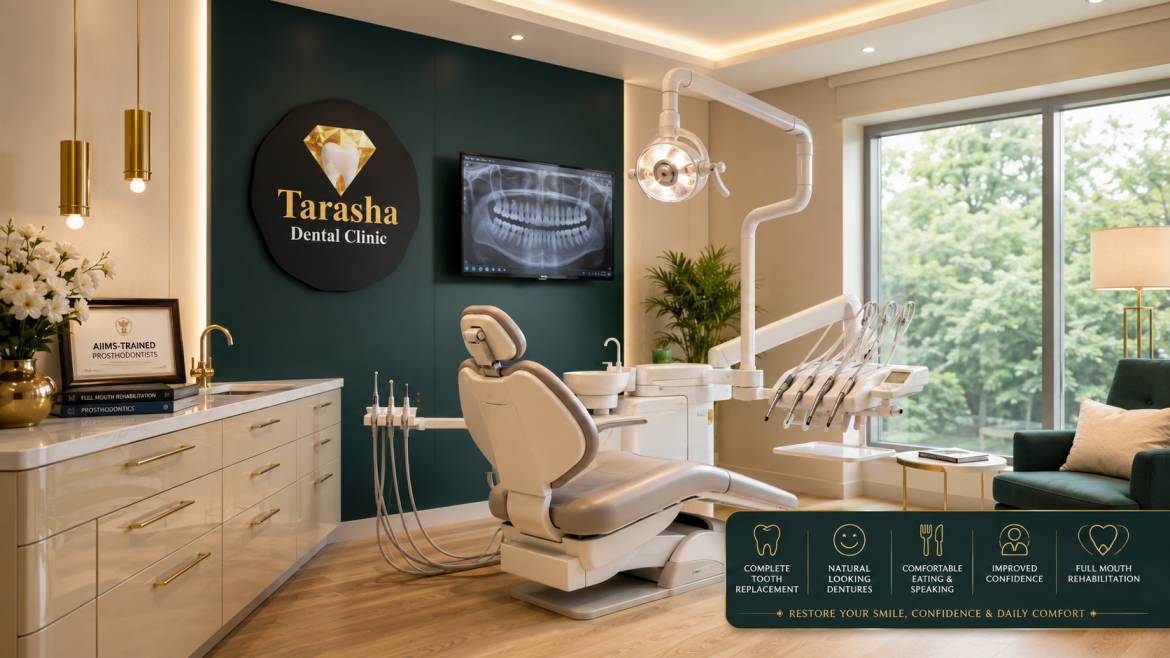
Single Tooth Implant in South Delhi —
The Most Natural Way to Replace a Missing Tooth
Even one missing tooth can affect your confidence, your bite, and the long-term health of your jawbone. A single tooth implant at Tarasha Dental Clinic — planned digitally by AIIMS-trained specialists — replaces it with a permanent, natural-looking solution that functions just like the tooth you lost.
What Is a Single Tooth Implant?
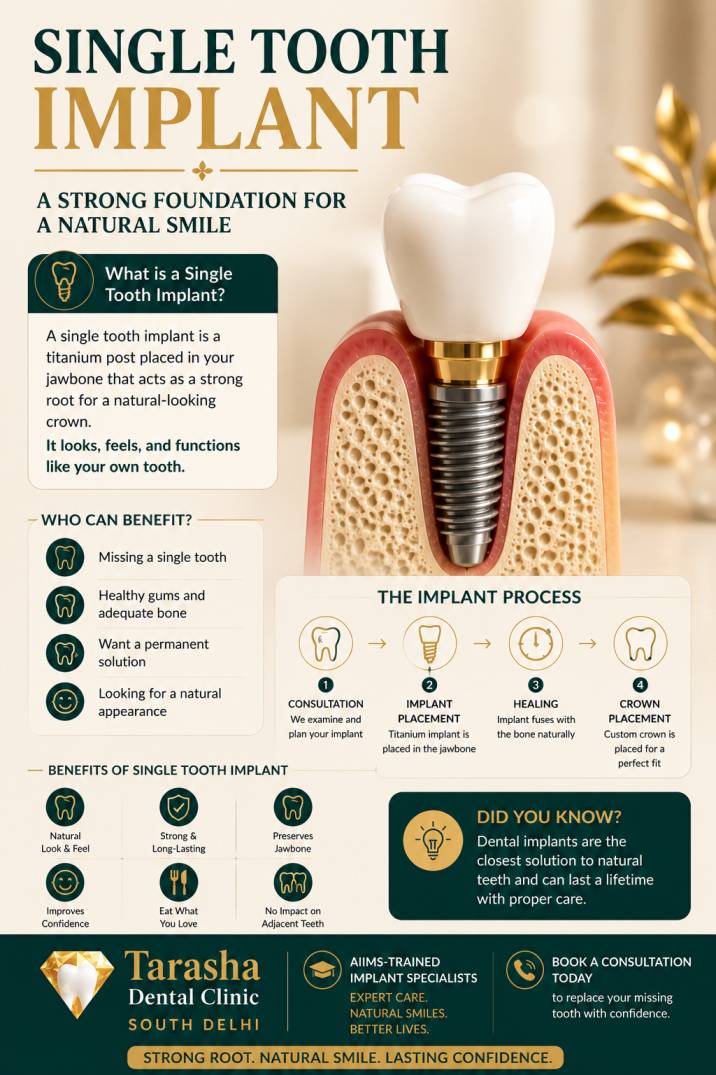
A single tooth implant is a titanium post surgically placed in the jawbone to replace the root of one missing tooth, topped with a custom crown that matches your natural teeth. It looks, feels, and functions like a real tooth — without affecting the teeth on either side.
What Is a Single Tooth Implant?
A single tooth implant has three components: a titanium implant post that replaces the root of your missing tooth, an abutment that connects the post to the visible tooth, and a custom-fabricated crown that recreates the size, shape, and shade of the tooth you lost.
Unlike a bridge, which depends on the teeth beside the gap for support, a single implant stands entirely on its own — anchored directly into the jawbone. This is what makes implants the closest restoration to a natural tooth in both function and long-term biological behaviour: the implant stimulates the bone the way a natural root would, and neighbouring teeth are left completely untouched.
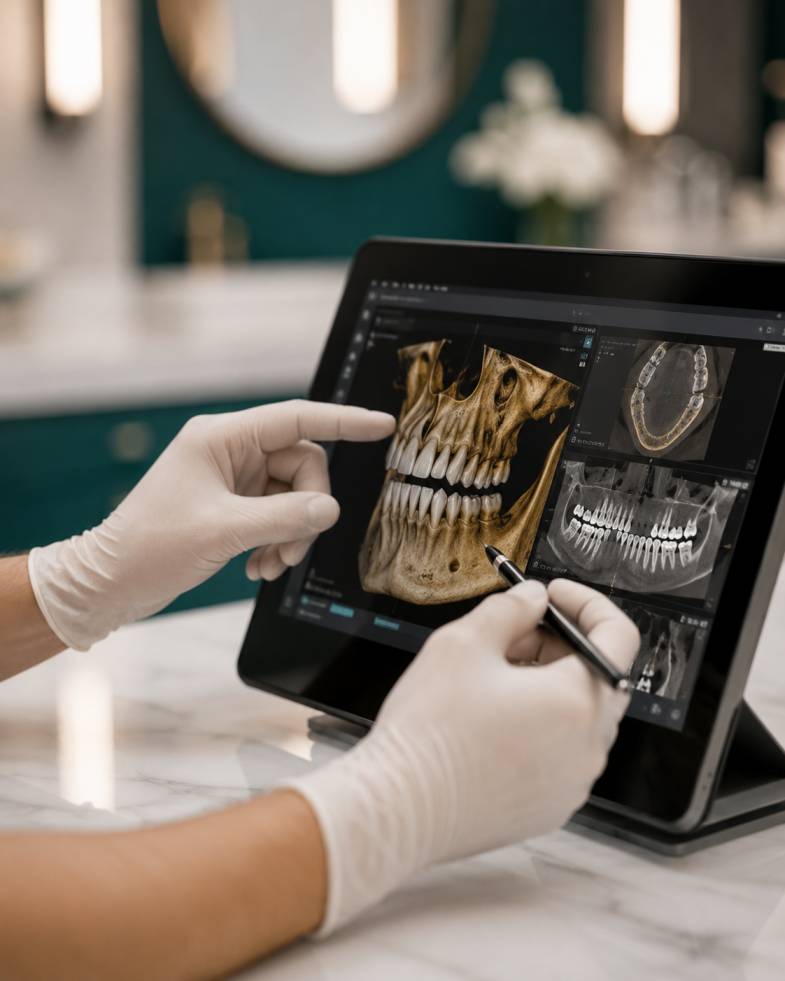
At Tarasha Dental Clinic, single tooth implants in South Delhi are planned using CBCT 3D imaging and placed by Dr. Niraj (MDS, AIIMS Alumni — Prosthodontics & Implantology), ensuring precise positioning and a crown that blends seamlessly with your smile.
For patients with multiple missing teeth, the same principle scales up — see our pages on full mouth dental implants and implant-supported overdentures for those broader solutions.

- Implants needed: 1 per missing tooth
- Adjacent teeth: Untouched, undamaged
- Healing period: 3–6 months
- Implant lifespan: 15–25+ years
- Success rate: 95–98% in healthy patients
Why Replace
a Missing Tooth?
A single missing tooth is often dismissed as a minor cosmetic issue — but the clinical consequences of leaving the gap untreated are significant and progressive.
Prevent Bone Loss
Without a tooth root stimulating it, the jawbone at the missing tooth site begins to resorb within months — a process that accelerates the longer the gap is left untreated.
Prevent Teeth Shifting
Neighbouring teeth gradually drift into the empty space, and the opposing tooth can over-erupt — disrupting your bite alignment and creating new problems beyond the original gap.
Restore Chewing Function
A missing tooth changes how you chew, often shifting load disproportionately onto other teeth and creating uneven wear over time.
Improve Smile Aesthetics
Particularly for visible teeth, a gap affects confidence in everyday situations — conversations, photographs, and simply smiling without hesitation.
Improve Speech
Certain missing teeth, particularly front teeth, can affect specific speech sounds. Restoring the tooth restores normal speech patterns.
Protect Oral Health
Gaps create new spaces where food and bacteria accumulate, increasing the risk of decay and gum disease in the surrounding teeth.
Benefits of Single Tooth Implants
- 01
Natural Appearance
A custom crown matched precisely to your surrounding teeth in shape, shade, and translucency — indistinguishable from a natural tooth.
- 02
Permanent Tooth Replacement
Unlike removable options, an implant is fixed permanently — brushed and cared for exactly like your natural teeth.
- 03
Preserves Jawbone
The implant post stimulates the jawbone the same way a natural root does, preventing the bone resorption that follows untreated tooth loss.
- 04
Protects Adjacent Teeth
Unlike a bridge, an implant requires no alteration of the neighbouring healthy teeth — they remain completely untouched and undamaged.
- 05
Improved Comfort
Once healed, an implant feels and functions like your own tooth — no awkward removable appliance, no clasps, no adjustment to daily habits.
- 06
Better Chewing Efficiency
A single implant restores close to full natural biting force at that tooth position — far beyond what a removable partial denture can offer.
- 07
Long-Term Durability
With good oral hygiene, the implant post can last 15–25+ years or longer — making it the most durable single-tooth replacement option available.
- 08
Easy Maintenance
No special cleaning routine required — brush and floss the implant crown exactly as you would a natural tooth.
Single Tooth Implant
vs Dental Bridge
This is one of the most common questions patients ask when deciding how to replace one missing tooth. Here is an honest, direct comparison.
| Feature | Single Tooth Implant | Dental Bridge |
|---|---|---|
| Longevity | 15–25+ years | 10–15 years |
| Bone Preservation | Yes — stimulates jawbone | No — bone continues to resorb |
| Adjacent Tooth Damage | None — stands independently | Healthy teeth must be filed down for support |
| Maintenance | Brush and floss like a natural tooth | Special floss threaders required under the bridge |
| Appearance | Indistinguishable from natural tooth | Good, but can show gum margin over time |
| Comfort | Feels exactly like a natural tooth | Good, but relies on adjacent teeth for support |
| Success Rate | 95–98% | 85–90% over 10 years |
| Surgery Required | Yes — minor implant placement | No |
| Initial Cost | Higher | Lower |
The clinical consensus across global dentistry strongly favours single tooth implants over bridges wherever a patient is medically suitable — primarily because implants do not require sacrificing healthy adjacent teeth, and they preserve the jawbone in a way bridges cannot. A bridge remains a reasonable option for patients who are not surgical candidates or who prioritise a lower upfront cost. Discuss your specific case with a Tarasha specialist ↗
Single Tooth Implant vs
Removable Partial Denture
For a single missing tooth, a removable partial denture is the most affordable option — but it comes with significant trade-offs against a fixed implant.
| Feature | Single Tooth Implant | Removable Partial Denture |
|---|---|---|
| Stability | Fixed permanently | Removable; can shift while eating |
| Comfort | Feels like a natural tooth | Clasps can cause irritation |
| Appearance | Indistinguishable from natural tooth | Visible clasps possible |
| Longevity | 15–25+ years | 5–7 years |
| Daily Maintenance | Brush like a natural tooth | Must be removed and cleaned separately |
Who Is a Candidate for
Single Tooth Implants?
One Missing Tooth
Patients missing a single tooth anywhere in the mouth — front or back — from extraction, trauma, or decay.
Healthy Gums
No active gum disease at the implant site; existing gum issues are treated first before implant placement.
Adequate Jawbone
Sufficient bone volume to anchor the implant; CBCT imaging confirms this precisely, and grafting is an option if bone volume is limited.
Non-Smokers Preferred
Smoking increases implant failure risk; non-smokers see the highest success rates, though smokers can still be candidates with appropriate counselling.
Seeking Long-Term Solutions
Patients who want a permanent, low-maintenance replacement rather than a removable or adjacent-tooth-dependent option.
General Good Health
Well-controlled systemic health (including diabetes, if present) supports predictable healing and implant success.
The Single Tooth Implant
Procedure at Tarasha
Consultation
Clinical examination, discussion of your goals, and an honest assessment of suitability for implant treatment.
CBCT Scan
3D imaging maps bone volume, density, and nerve position at the implant site with complete precision.
Digital Implant Planning
The implant position, angle, and depth are planned virtually before any surgery begins.
Implant Placement
Under local anaesthesia, the titanium implant is placed precisely according to the digital plan. The procedure typically takes 30–60 minutes.
Healing Phase
Osseointegration — the implant fusing with the jawbone — takes 3–6 months. A temporary restoration may be provided during this period.
Crown Placement
Once integration is confirmed, the custom crown — shade-matched and shaped to your natural teeth — is permanently attached.
Follow-Up Care
Review appointments confirm the implant and crown are functioning well, with ongoing 6-monthly check-ups as part of routine care.
Advanced Implant Technology
at Tarasha Dental Clinic
- CBCT 3D imaging — precise bone mapping before any surgical planning begins
- Guided implant surgery — digital surgical guides translate the plan to the operating field with millimetre accuracy
- Digital diagnostics — intraoral scanning eliminates uncomfortable traditional impressions
- Precision planning software — implant position virtually verified against nerves, sinuses, and adjacent roots before surgery
- Modern sterilisation standards — Class B autoclaves and WHO-compliant surgical protocols for every implant case
Why Choose AIIMS-Trained
Implant Specialists?
Even a single tooth implant requires precise anatomical knowledge and surgical judgment. AIIMS post-graduate Implantology training is the most rigorous in India, producing specialists who bring evidence-based protocols and significant case experience to every implant — even the simplest single-tooth case.
Advanced Training
AIIMS Prosthodontics and Implantology training covers the full spectrum of implant dentistry under the most rigorous supervision in Indian dental education.
Implant Expertise
Dr. Niraj (MDS, AIIMS Alumni) has placed implants across single-tooth and complex full-arch cases, bringing depth of experience to every consultation.
Precision Treatment
Digital planning ensures every implant — even a single tooth — is placed with the same rigour applied to the most complex cases.
Evidence-Based Dentistry
Recommendations are based on clinical evidence, not commercial incentive — including honest guidance on implants vs bridges vs partial dentures.
Long-Term Success Focus
Case selection, surgical precision, and structured follow-up are all designed around the implant lasting decades, not just years.
Patient-Centred Care
Unhurried consultations, clear explanations, and treatment plans built around what is right for you — not what is easiest to sell.
Implant Dentist Near
Lajpat Nagar & South Delhi
Tarasha Dental Clinic is located in Lajpat Nagar I, easily accessible across South Delhi. We proudly serve patients from Lajpat Nagar, Defence Colony, Amar Colony, South Extension, Jangpura, Moolchand, and nearby South Delhi neighbourhoods seeking trusted, AIIMS-led implant care close to home.
Single Tooth Implants for
International Patients
For NRIs and overseas patients, single tooth implants in India offer the same AIIMS-trained quality at significantly lower cost than the USA, UK, Canada, or Australia.
Online Consultation
Share X-rays or photographs via WhatsApp before booking flights.
Implant Placed on Visit One
Surgery completed on your first visit; temporary restoration provided.
Heal at Home
Digital records provided for your home dentist; Tarasha team accessible via WhatsApp.
Crown on Visit Two
Return after 3–6 months for the final crown placement.
How Long Does a Single Tooth Implant Last?
A single tooth implant can last 15 to 25 years or longer, often for life, with good oral hygiene and regular dental check-ups. The crown attached to the implant typically lasts 10–15 years before it may need replacement due to normal wear.
- Oral hygiene — daily brushing and flossing around the implant prevents peri-implantitis, the leading cause of implant failure
- Regular check-ups — 6-monthly professional cleaning and implant review
- Avoiding smoking — significantly improves long-term implant survival
- Night guard if grinding — protects the crown from excessive force
Cost of Single Tooth Implant
in South Delhi
- Implant brand — internationally proven systems vary in cost
- Bone grafting requirements — needed if bone volume is limited at the implant site
- Crown material — zirconia, e-max, or porcelain-fused-to-metal have different cost profiles
- Complexity — straightforward cases cost less than those requiring additional procedures
- Technology used — CBCT imaging and guided surgery are included in your treatment plan
Complete cost transparency is provided at your consultation, in writing, before any commitment.
Quick Answers About
Single Tooth Implants
What is a Single Tooth Implant?
A titanium post placed in the jawbone to replace one missing tooth root, topped with a custom crown. Functions and looks like a natural tooth without affecting neighbouring teeth.
Why replace one missing tooth?
An untreated gap causes jawbone loss, shifting of nearby teeth, bite misalignment, and increased risk of decay in surrounding teeth over time.
Are implants permanent?
Yes — the titanium implant post is designed to be a permanent, fixed replacement, lasting 15-25+ years with proper care. The crown may need replacement after 10-15 years.
Are implants safe?
Yes — dental implants are a well-established, extensively studied procedure with a 95-98% success rate when placed by a qualified specialist in suitable patients.
How long do implants last?
The implant post can last 15 to 25 years or longer, often for life, with good oral hygiene, regular check-ups, and avoidance of smoking.
Do implants look natural?
Yes — the custom crown is shade-matched and shaped to blend seamlessly with surrounding teeth, making it indistinguishable from a natural tooth.
Single Tooth Implant
FAQs
Everything patients ask before choosing a single tooth implant — answered honestly by the Tarasha team.
“One missing tooth, one straightforward conversation. Book your consultation today.”
Book Your Consultation ↗-
A single tooth implant is a titanium post surgically placed in the jawbone to replace the root of one missing tooth, with a custom crown attached on top. It looks, feels, and functions like a real tooth, without affecting the teeth on either side. At Tarasha Dental Clinic, single tooth implants are planned with CBCT 3D imaging and placed by Dr. Niraj (MDS, AIIMS Alumni — Prosthodontics).
-
Implant placement is performed under local anaesthesia and should not be painful during surgery — patients typically feel pressure but not pain. Mild discomfort for 2–3 days afterward is normal and well-managed with standard pain medication. Most patients find a single implant placement considerably easier than they expected.
-
A dental implant post can last 15 to 25 years or longer, often for life, with good oral hygiene and regular dental check-ups. The crown on top typically lasts 10–15 years before it may need replacement due to normal wear — a straightforward process that does not involve the implant itself.
-
For most patients who are suitable candidates, yes. Implants preserve the jawbone, do not require altering healthy adjacent teeth, and last significantly longer (15–25+ years vs 10–15 for a bridge). A bridge remains a reasonable option for patients who are not surgical candidates or who prioritise lower upfront cost. Your Tarasha specialist will discuss both options honestly based on your specific case.
-
Yes — a single tooth implant is specifically designed for exactly this situation. One implant replaces one missing tooth, anchored independently in the jawbone without involving or damaging the teeth on either side. This is one of the most common and well-established applications of implant dentistry.
-
Total treatment time is typically 3–6 months. Implant placement surgery takes 30–60 minutes. Healing (osseointegration) requires 3–6 months before the final crown can be placed. International patients often have the implant placed on a first visit and return for the crown on a second visit after healing.
-
Dental implants have a 95–98% success rate in healthy patients with adequate bone volume, placed by a qualified specialist. Factors that can lower this slightly include smoking, uncontrolled diabetes, and inadequate oral hygiene — all of which are discussed and managed at your consultation to maximise your individual success rate.
-
For implant treatment, AIIMS-trained Prosthodontists bring the most rigorous surgical and anatomical training available in Indian dentistry. At Tarasha Dental Clinic, Lajpat Nagar, Dr. Niraj (MDS, AIIMS Alumni) leads all implant cases using CBCT digital planning and guided surgery — from single tooth implants to full arch restorations.
-
Yes — NRIs and international patients regularly choose Tarasha for single tooth implants, benefiting from AIIMS-trained quality at significantly lower cost than the USA, UK, Canada, or Australia. Online consultations before travel, implant placement on the first visit, and crown placement on a return visit make the process manageable. Begin your consultation online.
-
Implant success depends on precise surgical placement, accurate bone and anatomy assessment, and appropriate case selection. AIIMS post-graduate training is the most rigorous implant dentistry programme in India — producing specialists with the anatomical depth and surgical precision that even a single tooth implant deserves. The qualification of your specialist is the single most important factor in your outcome.
Replace Your Missing Tooth.
Permanently and Naturally.
A single missing tooth deserves a permanent, precise solution — not a compromise. Tarasha Dental Clinic brings AIIMS-trained precision, digital implant planning, and an honest consultation process to every single tooth implant case.
Single Tooth Implants · Dental Implants · Smile Restoration — all available under one roof in South Delhi.
Tarasha Dental Clinic · An Initiative by AIIMS Alumni
SCO 2&3, D-177, Railway Crossing, Lajpat Nagar I, New Delhi – 110024
Mon – Sat: 10:30 am – 8:00 pm · tarashadental.com