

Space Maintainers in South Delhi —
Protect Your Child’s Future Smile
Losing a baby tooth too early can set off a chain of dental problems that may take years of orthodontic treatment to correct. A Space Maintainer preserves the gap left by a premature tooth loss until the permanent tooth erupts naturally — preventing crowding, shifting, and bite problems before they begin. Simple, gentle, child-friendly treatment by an AIIMS Alumni-led paediatric dental team.
What Is a Space Maintainer for Children?
A Space Maintainer is a custom-made paediatric dental appliance placed after the premature loss of a baby tooth to hold the gap open until the permanent successor tooth erupts naturally. Without it, adjacent teeth drift into the empty space, causing crowding, misalignment, and bite problems that often require lengthy orthodontic treatment to correct. Space maintainers are a simple, cost-effective preventive orthodontic measure.
Why Are Baby Teeth
So Important?
“It’s just a milk tooth — it will fall out anyway.” This is one of the most consequential misunderstandings in children’s dentistry. Baby teeth are not temporary fillers — they are active participants in your child’s dental development, and their premature loss triggers a cascade of problems that can take years of orthodontic treatment to correct.
Each baby tooth performs specific developmental functions that cannot simply be “waited out”:
- Space reservation for permanent teeth — each baby tooth acts as a precise placeholder for the permanent tooth developing beneath it. When a baby tooth is lost too early, adjacent teeth begin drifting into the gap within weeks, narrowing or closing the space the permanent tooth needs to erupt correctly
- Jaw bone stimulation — baby tooth roots stimulate the underlying jaw bone, maintaining bone density. Premature loss reduces this stimulation and can affect bone volume in that area
- Chewing and nutrition — baby molars bear the full chewing load for years. Premature loss forces the child to chew only on one side, affecting jaw muscle development and nutritional intake
- Speech development — front baby teeth are essential for forming “f”, “v”, “th”, and “s” sounds. Early loss can create speech patterns that may require therapy to correct
- Jaw growth guidance — baby teeth collectively guide the eruption sequence of permanent teeth and the three-dimensional development of the jaw arches
- Bite development — the vertical and horizontal relationship of upper and lower teeth develops against the background of a full primary dentition. Premature losses can alter this developing bite relationship
Why Are Baby Teeth Important If They Fall Out Anyway?
Baby teeth hold space for permanent teeth, guide jaw growth, support speech development, enable chewing, and stimulate jawbone density. Premature loss of even one baby molar can cause adjacent teeth to drift and block the permanent successor — requiring orthodontic treatment that would not have been necessary had the space been maintained.

What Is a Space Maintainer
and How Does It Work?
A Space Maintainer is a small, custom-made dental appliance — fixed or removable — placed in the gap left by a prematurely lost baby tooth. Its function is precisely what the name describes: it maintains the space that the missing tooth was occupying, preventing the teeth on either side from drifting or tilting into the gap.
How It Works
A space maintainer is anchored to the tooth or teeth adjacent to the gap — typically using a metal band cemented around a neighbouring tooth. A wire loop or bar extends into the gap, physically blocking the teeth on either side from moving into it. The appliance exerts no active orthodontic force — it simply holds position passively until the permanent tooth below the gap is ready to erupt.
When the permanent tooth begins to erupt (confirmed by digital X-ray), the space maintainer is removed. The permanent tooth then erupts into the correctly maintained space, with a significantly better chance of erupting in proper alignment.
When Is It Recommended
A space maintainer is recommended whenever a primary (baby) tooth is lost significantly before its natural exfoliation time — typically more than 6–12 months before the permanent successor is expected to erupt. The paediatric dentist assesses this by estimating the permanent tooth’s eruption timeline from digital X-ray findings and the child’s age.
Its Preventive Orthodontic Role
Space maintainers are one of the most clinically impactful and cost-effective preventive interventions in paediatric dentistry. Research consistently shows that children who receive space maintainers after premature baby tooth loss have significantly lower rates of subsequent orthodontic crowding and misalignment compared to those who do not.
The cost of a space maintainer is a small fraction of the orthodontic treatment that may be required if the space is lost. For many families, a space maintainer is the difference between needing braces or not — or between needing braces for 12 months versus 30 months.
Can a Space Maintainer Prevent Braces?
A space maintainer cannot guarantee that braces will not be needed, as many factors influence orthodontic alignment. However, it significantly reduces the severity of crowding caused by premature tooth loss — often reducing the complexity and duration of any future orthodontic treatment. For some children, it prevents crowding entirely, meaning no braces are needed at all.
When Does a Child Need
a Space Maintainer?
When Does a Child Need a Space Maintainer?
A child needs a Space Maintainer when a baby tooth is lost significantly before the permanent successor is ready to erupt — usually more than 6–12 months early. This occurs after extraction due to severe decay or infection, after dental trauma causing tooth loss, or when a tooth fails despite root canal treatment. The paediatric dentist assesses eruption timing from digital X-rays to determine whether a maintainer is needed.
Premature Baby Tooth Loss
When a baby tooth is lost significantly before its natural exfoliation time — typically more than 6–12 months before the permanent tooth is expected to erupt — adjacent teeth begin drifting within weeks.
Extraction Due to Severe Decay
When a baby tooth is extracted due to extensive decay that cannot be restored with fillings or root canal treatment, a space maintainer is typically placed in the same appointment or shortly after.
Dental Trauma
Falls, sports injuries, or accidents causing avulsion (complete tooth loss) or irreparable fracture of a baby tooth may require space maintainer placement to protect the gap until the permanent successor erupts.
Congenitally Missing Teeth
When a permanent tooth is congenitally absent (hypodontia), the baby tooth space may need to be maintained for a longer period until a prosthetic or implant solution is planned at the appropriate age.
Extensive Dental Infection
Spreading periapical infection that destroys significant bone around a baby tooth root may necessitate extraction even when the tooth appears structurally present, requiring space maintenance immediately after.
After Kids Root Canal Treatment
When a pulpotomy or pulpectomy is eventually unsuccessful and the tooth must be extracted later, space maintenance is typically required to protect the space that had been maintained through the root canal treatment period. See kids root canal ↗.
“The decision to place a space maintainer is based on the child’s age, which tooth was lost, and the digital X-ray assessment of when the permanent successor is expected to erupt. Not every premature tooth loss needs a maintainer — but when one is indicated, the earlier it is placed, the less drift has already occurred, and the more effective it is.”
— Dr. Anju Singh Rajwar, MDS Paediatric Dentistry, AIIMS New Delhi · Founder, Tarasha Dental ClinicTypes of Space Maintainers
Used for Children
Space maintainers are broadly divided into Fixed (cemented in place — child cannot remove them) and Removable (taken out for cleaning — suitable for older, more cooperative children). The type recommended depends on which tooth was lost, the child’s age, cooperation level, and the eruption timeline of the permanent successor.
Fixed Space Maintainers
Band and Loop
A metal band is cemented around the tooth adjacent to the gap, with a stainless steel wire loop extending into the space to prevent the adjacent tooth from drifting. The most commonly used fixed space maintainer.
Best for: Single premolar or molar space in one quadrant
UnilateralCrown and Loop
Similar to Band and Loop but the anchor unit is a full stainless steel crown rather than a band — used when the anchor tooth also needs crown restoration (e.g., after pulpotomy). Combines tooth restoration with space maintenance in one appliance.
Best for: When the adjacent tooth requires a crown anyway
UnilateralDistal Shoe
A specialised fixed maintainer with an intraosseous (below the gum) component that guides the unerupted first permanent molar into its correct position. Used when the second baby molar is lost before the first permanent molar has erupted.
Best for: Loss of second primary molar before first permanent molar eruption
Specialised · FixedLingual Holding Arch
A bilateral lower arch maintainer — a wire running along the inside (lingual surface) of the lower front teeth, connected to molar bands on both sides. Prevents the lower molars from drifting forward or the lower arch from collapsing when multiple lower baby teeth are lost.
Best for: Bilateral premature loss of lower primary teeth
Bilateral · Lower archNance Appliance
An upper arch space maintainer anchored to the upper first permanent molars with a wire resting on the roof of the mouth (palate). Prevents forward movement of upper molars. Often used after loss of multiple upper primary teeth.
Best for: Bilateral premature loss of upper primary teeth; preventing upper molar drift
Bilateral · Upper archRemovable Space Maintainer
A removable acrylic appliance with wire components that the child can take out for eating, brushing, and sports. Available in tooth-coloured acrylic with an artificial tooth in the space for aesthetic appearance.
Best for: Older cooperative children (typically 8+); when aesthetics of the gap matters; multiple adjacent spaces
Limitation: Depends entirely on compliance — lost or forgotten appliances mean no space maintenance. Not recommended as first choice for young children.
Removable · Compliance-dependentBenefits of Space Maintainers
for Your Child’s Future Smile
What Happens If a Space Maintainer
Is Not Used?
What Happens If a Child Doesn’t Get a Space Maintainer After Early Tooth Loss?
Without a space maintainer after premature baby tooth loss, adjacent teeth begin drifting into the gap within weeks. This narrows or closes the space the permanent tooth needs to erupt. The permanent tooth then erupts in the wrong position — causing crowding, crooked teeth, bite problems, and often requiring significantly more complex and lengthy orthodontic treatment to correct than would have been needed otherwise.
Tooth Crowding
Adjacent teeth drift into the gap, reducing space in the arch. The permanent successor tooth has insufficient space to erupt correctly, causing it to be crowded, tilted, or partially impacted.
Crooked Permanent Teeth
Permanent teeth that erupt into narrowed spaces emerge at incorrect angles — rotated, tilted, or displaced — even if they would have erupted correctly in a well-maintained arch.
Bite Problems
Space loss in one area can affect the entire bite relationship. Crossbites, deep bites, or open bites may develop as the eruption sequence is disrupted by the missing space.
Loss of Permanent Tooth Space
In severe cases, the permanent tooth may have no space to erupt at all and becomes impacted in the jaw — requiring surgical exposure or extraction in the future.
More Complex Orthodontics
Correcting crowding caused by space loss requires active orthodontic treatment — brackets, wires, space creation with expanders or extractions — rather than simple alignment. Treatment time is significantly longer.
Higher Treatment Cost
Orthodontic treatment to create and align space after it has been lost costs many times more than a preventive space maintainer. Prevention is measurably more cost-effective.
Space Maintainer Procedure:
Step by Step
Paediatric Consultation
Dr. Anju examines the gap, the adjacent teeth, and the child’s full dental arch. Medical history and dental history are reviewed. The child’s cooperation level and anxiety are assessed. A child-friendly explanation of what will happen is given.
Digital X-Ray Assessment
A digital periapical X-ray of the affected area confirms the stage of development of the permanent successor tooth, the amount of bone above it, and the estimated eruption timeline. This determines whether a space maintainer is indicated and for how long it will likely need to stay in place.
Type Selection & Impression or Digital Scan
Based on the X-ray findings, clinical assessment, and the child’s age and cooperation, the most appropriate type of space maintainer is selected. An impression of the dental arch is taken (or a digital intraoral scan used) to fabricate the custom appliance.
Appliance Fabrication
The custom space maintainer is fabricated in the dental laboratory to precise specifications from the impression or scan. Typically completed in 3–5 working days. A temporary appliance or instructions are provided in the interim if needed.
Placement
The space maintainer is fitted and cemented or adjusted at a short return appointment. No anaesthesia is required for placement in most cases. Dr. Anju confirms the fit, checks that it does not interfere with the bite or adjacent teeth, and demonstrates cleaning to the parent.
Regular Follow-Up
Follow-up appointments every 3–6 months to check appliance integrity, monitor eruption progress of the permanent tooth, and confirm the arch is developing correctly. The maintainer is removed when the permanent tooth begins to erupt (confirmed by clinical and X-ray assessment).
Removal
When the permanent tooth is confirmed to be erupting correctly, the space maintainer is removed at a simple appointment. No anaesthesia required. The appliance has served its purpose — and the permanent tooth continues to erupt into the correctly maintained space.
How to Care for Your Child’s
Space Maintainer
Daily Oral Hygiene
- Brush normally — brush the space maintainer as part of normal brushing routine, morning and evening. Use a soft-bristled child’s toothbrush and fluoride toothpaste
- Clean around the band — gently brush around the metal band where it meets the tooth and gum to prevent plaque accumulation and gum irritation at the margin
- Rinse after meals — water rinsing after meals removes food debris that may accumulate around the wire loop
- Floss the other teeth — use floss threader if needed to floss around the maintainer area; maintain normal flossing for all other teeth
Foods to Avoid
- Sticky or chewy sweets — toffees, gummy bears, caramels, and similar confectionery can pull the band off the tooth or distort the wire loop
- Hard foods — ice cubes, hard boiled sweets, and very hard snacks can bend or break the wire component
- Chewing gum — gets stuck to the appliance and can displace it
- Biting on pencils or objects — habitual object chewing can distort the appliance
Warning Signs to Report
- Appliance feels loose or moves — the band may have come partially off; call Tarasha for an assessment appointment
- Wire is bent or broken — a distorted wire no longer maintains the space correctly; bring the child in for repair or replacement
- Gum swelling near the band — may indicate plaque accumulation under the band margin; professional cleaning and hygiene review needed
- Child reports persistent discomfort — mild awareness for a few days after placement is normal; persistent discomfort warrants a review
- Appliance comes out — keep the appliance safely and contact Tarasha immediately; space drift begins within days of an appliance being out
Regular Follow-Up
Follow-up appointments every 3–6 months are essential — not optional. The dentist checks appliance integrity, monitors the permanent tooth’s eruption progress, and confirms the space is being maintained correctly. These visits are the quality assurance mechanism for the entire programme.
Why Choose Tarasha Dental Clinic
for Space Maintainers in South Delhi?
Space maintainer placement is a straightforward procedure technically — but the clinical judgement that determines whether one is needed, which type, and how long it should remain, requires paediatric specialist training and systematic growth monitoring. At Tarasha, this assessment is made by Dr. Anju Singh Rajwar, MDS Paediatric Dentistry, Senior Residency AIIMS New Delhi — a specialist whose training includes systematic growth and development monitoring as a core clinical competency.
AIIMS Alumni Specialist
MDS Paediatric Dentistry from AIIMS New Delhi — systematic training in preventive orthodontics, growth monitoring, and early interceptive treatment. Space maintainers placed and monitored by a paediatric specialist, not a general practitioner.
Digital X-Ray Assessment
All space maintainer decisions are supported by digital radiographic assessment of permanent tooth development. Lower radiation than conventional X-rays. Precise eruption timeline estimation for correct appliance selection.
All Types Available
Band and Loop, Crown and Loop, Distal Shoe, Lingual Holding Arch, Nance Appliance, and Removable maintainers — all types fabricated and placed in-house. The clinically appropriate type selected, not the most convenient.
Child-Friendly Approach
Space maintainer placement is explained in age-appropriate language before the appointment. The procedure is gentle, quick, and well-tolerated by most children. No anaesthesia required for placement in most cases.
Systematic Follow-Up
Regular review appointments are integral to the programme — not optional extras. Eruption progress is monitored at every visit and the maintainer removed at precisely the right moment.
International Patient Programme
Pre-travel assessment of X-rays via WhatsApp. Cost estimates in USD, GBP, CAD, AED, or AUD. Space maintainer placed during India visit. Follow-up monitored at 6-monthly India family trips. See international patients ↗.
Space Maintainers in India —
For NRI & International Families
NRI and international families regularly bring their children for preventive paediatric dental care — including space maintainer assessment and placement — at Tarasha during India family visits. The combination of AIIMS Alumni specialist expertise and significantly lower cost compared to USA/UK private dental rates makes this a highly practical addition to an existing India family trip. WhatsApp assessment of existing X-rays before travel allows Dr. Anju to confirm whether a space maintainer is indicated and have the case ready for placement on arrival.
India vs USA/UK Cost Comparison — Space Maintainer Treatment
| Component | India — Tarasha (approx.) | USA (approx.) | UK (approx.) |
|---|---|---|---|
| Paediatric Specialist Consultation | Significantly lower | $150–$300 | £80–£200 |
| Digital Periapical X-Ray | Significantly lower | $50–$150 | £30–£80 |
| Band and Loop Space Maintainer | Save 60–75% | $300–$600 | £200–£400 |
| Lingual Holding Arch (bilateral) | Save 65–75% | $500–$900 | £350–£600 |
| Nance Appliance | Save 65–75% | $500–$900 | £350–£600 |
| Distal Shoe Maintainer | Save 60–75% | $400–$800 | £300–£500 |
| Follow-Up Appointments | Significantly lower | $75–$200 each | £50–£150 each |
| Waiting Time | Days (not weeks) | 2–6 weeks | 4–10 weeks |
| Overall Savings | 50–75% | Depending on type and complexity | |
* India costs confirmed at your consultation. USA/UK figures based on published average fee surveys. For full international patient information, see our international patients page ↗.
NRI or International Family?
WhatsApp Your Child’s X-Rays for a Free Assessment.
Send your child’s dental X-rays and tell us which tooth was lost. Dr. Anju will review the case and confirm whether a space maintainer is needed, the recommended type, and the cost in your home currency — before your India visit.
Space Maintainers in the
Heart of South Delhi
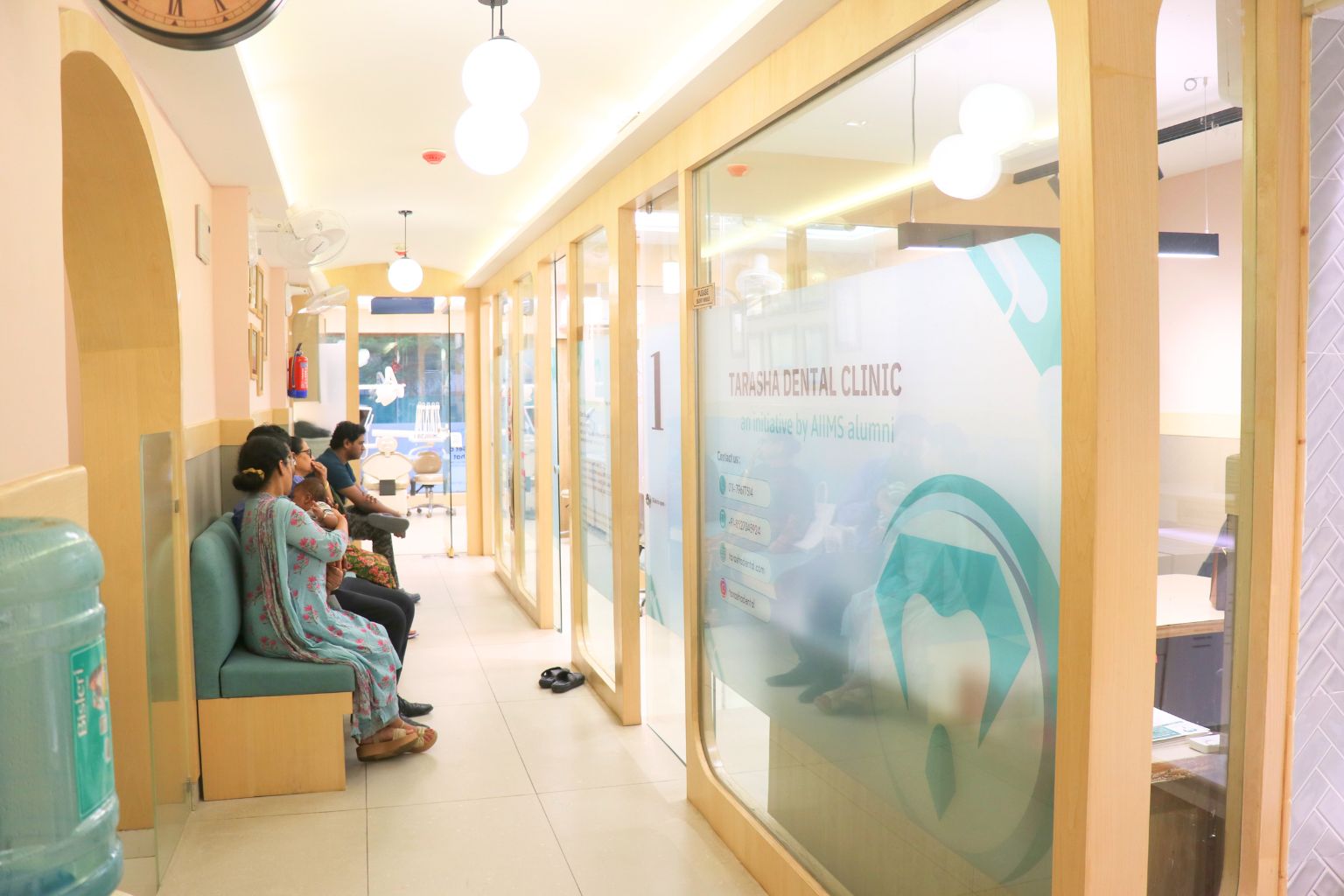
Families from Lajpat Nagar, Defence Colony, Amar Colony, South Extension, Jangpura, Greater Kailash, East of Kailash, Moolchand, Nehru Place, and across South Delhi trust Tarasha Dental Clinic for advanced preventive paediatric dental care and Space Maintainer treatment. Our clinic is located at SCO 2&3, D-177, Railway Crossing, Lajpat Nagar I, New Delhi – 110024, easily accessible from Lajpat Nagar and Moolchand Metro Stations.
Quick Answers —
Space Maintainers for Children
What is a Space Maintainer?
A custom-made paediatric dental appliance placed in the gap left by a prematurely lost baby tooth. It holds the space open for the permanent successor tooth, preventing adjacent teeth from drifting and causing crowding, misalignment, and bite problems in the permanent dentition.
Why is a Space Maintainer important?
Without a space maintainer after early tooth loss, adjacent teeth drift into the gap within weeks. The permanent tooth then erupts with insufficient space, causing crowding and misalignment that requires orthodontic correction — significantly more expensive and time-consuming than preventive space maintenance.
When is a Space Maintainer needed?
When a baby tooth is lost more than 6–12 months before the permanent successor is expected to erupt — due to severe decay, infection, extraction, dental trauma, or root canal treatment failure. The paediatric dentist determines this from digital X-ray assessment of the permanent tooth's development stage.
Is a Space Maintainer removable?
Fixed space maintainers (Band and Loop, Crown and Loop, Lingual Arch, Nance) are cemented in place and cannot be removed by the child — preferred for young children and long-term maintenance. Removable space maintainers are available for older cooperative children (typically 8+) where compliance can be ensured.
How long does a Space Maintainer stay in place?
Until the permanent successor tooth begins to erupt into the maintained space — confirmed by clinical and X-ray assessment. This typically ranges from 6 months to 2–3 years depending on the child's age when the tooth was lost and which tooth it was. The maintainer is removed at a simple appointment when the permanent tooth is erupting correctly.
Can a Space Maintainer prevent braces?
It significantly reduces the severity of crowding caused by premature tooth loss — for many children, it prevents the specific crowding that would have required braces entirely. Even where orthodontic treatment is still needed, space maintenance during childhood reduces treatment duration and complexity considerably.
Frequently Asked Questions —
Space Maintainers South Delhi
-
A Space Maintainer is a custom-made paediatric dental appliance placed in the gap left by a prematurely lost baby tooth. It holds the space open for the permanent successor tooth, preventing the teeth on either side from drifting and closing the gap. Without it, crowding, misalignment, and bite problems can develop in the permanent dentition.
-
When a baby tooth is lost prematurely, the teeth on either side begin drifting into the gap within weeks. This reduces or closes the space the permanent tooth needs to erupt correctly. A space maintainer physically blocks this drift, ensuring the permanent tooth has the space it needs — preventing crowding that would otherwise require orthodontic correction.
-
No — placement is typically quick, comfortable, and does not require anaesthesia. The child may be aware of the appliance for a few days after placement, particularly during eating, but this is not pain. Most children adapt fully within a week. If persistent discomfort occurs, the appliance is reviewed and adjusted.
-
Until the permanent successor tooth begins to erupt into the maintained space — confirmed by clinical and X-ray assessment. This varies from 6 months to 2–3 years depending on the child's age when the tooth was lost and which tooth it was. It is removed at a simple appointment when the permanent tooth is erupting correctly.
-
Yes — normal eating resumes within a few days of placement. Specific foods to avoid include sticky sweets (toffees, gummies), hard candies, chewing gum, and very hard foods that could displace or bend the appliance. A normal, balanced diet is otherwise unrestricted. Parents should avoid sending these specific foods in the child's lunchbox during the maintenance period.
-
Contact Tarasha immediately and bring the appliance in. Adjacent teeth begin drifting within days of an appliance being out. If the appliance is intact, it can usually be re-cemented quickly. If it has been distorted, a new one is fabricated. Do not wait — even a few weeks without a maintainer can result in measurable space loss.
-
Not always. The need depends on the child's age, which tooth was extracted, and the development stage of the permanent successor. If the permanent tooth is expected to erupt within 6 months, a maintainer may not be necessary. If the gap will be open for longer than 6–12 months, a space maintainer is typically recommended. This is determined by digital X-ray assessment.
-
Fixed space maintainers (cemented in): Band and Loop (single space), Crown and Loop (with crown on adjacent tooth), Distal Shoe (for very young children before first permanent molar eruption), Lingual Holding Arch (bilateral lower arch), Nance Appliance (bilateral upper arch). Removable space maintainers: acrylic appliances for older cooperative children — compliance-dependent and not recommended as first choice for young children.
-
A space maintainer significantly reduces the crowding caused by premature tooth loss — for many children, it prevents the specific crowding that would have required orthodontic correction. Even when braces are eventually needed for other reasons, space maintenance reduces treatment complexity and duration. It is one of the most cost-effective preventive orthodontic interventions available.
-
Tarasha Dental Clinic, SCO 2&3, D-177, Railway Crossing, Lajpat Nagar I, New Delhi – 110024. Led by Dr. Anju Singh Rajwar, MDS Paediatric Dentistry, Senior Residency AIIMS New Delhi. An AIIMS Alumni initiative. Mon–Sat, 10:30am–8pm. +91 96259 52590. Serving Lajpat Nagar, Defence Colony, Amar Colony, Jangpura, South Extension, Greater Kailash, East of Kailash, Moolchand, and Nehru Place.
-
Yes. NRI and international families regularly include space maintainer assessment and placement during India family visits. WhatsApp assessment of existing X-rays before travel allows Dr. Anju to confirm whether a maintainer is needed and have the case ready for placement on arrival. Cost estimates in USD, GBP, CAD, or AED are provided before travel.
-
Space maintainer decisions require specialist clinical judgement — which type, whether one is needed, and for how long — that is informed by formal paediatric dental training in preventive orthodontics and growth monitoring. AIIMS MDS Paediatric Dentistry training includes this systematically. The appliance itself is simple; the clinical decision-making around it requires specialist competency.
-
The consultation and X-ray assessment is completed at the first visit. An impression or digital scan is taken at the same or a second short appointment. The appliance is fabricated in the dental laboratory over 3–5 working days. Placement at the fitting appointment takes approximately 20–30 minutes. Total time from consultation to appliance in place: typically 1–2 weeks.
-
A Lingual Holding Arch is a bilateral lower arch space maintainer — a wire running along the inside (lingual surface) of the lower front teeth, connected to metal bands on the lower first permanent molars on both sides. It prevents the lower molars from drifting forward and the lower dental arch from collapsing when multiple lower primary teeth are lost prematurely.
-
A Distal Shoe is a specialised fixed space maintainer used when the second primary molar is lost before the first permanent molar has erupted. It has a small intraosseous (below the gum) extension that guides the unerupted first permanent molar into its correct eruption path. It is the most technically specific space maintainer type and requires careful digital monitoring.
-
Yes — normal physical activity including sports is fine with a fixed space maintainer. For contact sports, a custom mouthguard is recommended (as it is for any dental appliance). The space maintainer itself does not restrict physical activity.
-
Fixed space maintainers (Band and Loop, Crown and Loop) have minimal impact on speech — they are small, sit along the side of the arch, and most children adapt within a few days. Bilateral arch maintainers (Lingual Arch, Nance) may cause minor lisping for 1–2 weeks as the tongue adapts, but speech normalises quickly in most children.
-
The cost of a space maintainer at Tarasha Dental Clinic is confirmed at your consultation appointment, as it depends on the type of appliance required (Band and Loop vs bilateral arch maintainer vs removable). Please call or WhatsApp us at +91 96259 52590 for a consultation and cost estimate. For international families: cost estimates in USD, GBP, CAD, or AED are provided before travel.
-
Yes. Bring the original appliance if available. Dr. Anju will assess how much space loss (if any) has occurred in the interim using a digital X-ray, determine whether re-cementation or a new appliance is needed, and place the replacement as quickly as possible. Contact us immediately — space drift begins within days of an appliance being out.
-
Call or WhatsApp +91 96259 52590, or book online at tarashadental.com/contact-dental-clinic-delhi/. Tarasha Dental Clinic is open Monday to Saturday, 10:30am to 8:00pm. Located at SCO 2&3, D-177, Railway Crossing, Lajpat Nagar I, New Delhi – 110024. Near Lajpat Nagar and Moolchand Metro Stations. NRI families: WhatsApp your child's X-rays for a free pre-travel assessment.
Act Now — Every Week Without
a Maintainer Is a Week of Drift.
If your child has lost a baby tooth too early, timely placement of a Space Maintainer can preserve the correct space for permanent teeth and reduce the need for complex orthodontic treatment in the future. The earlier it is placed, the less drift has occurred — and the more effective it is.
Book a consultation with the AIIMS Alumni-led paediatric dental team at Tarasha Dental Clinic for a personalised assessment and Space Maintainer treatment designed for your child’s specific dental situation.
Tarasha Dental Clinic · An Initiative by AIIMS Alumni
SCO 2&3, D-177, Railway Crossing, Lajpat Nagar I, New Delhi – 110024
Mon – Sat: 10:30 am – 8:00 pm · +91 96259 52590
Kids Dentistry ↗
·
Kids Root Canal ↗
·
Full Mouth Rehabilitation ↗
·
International Patients ↗