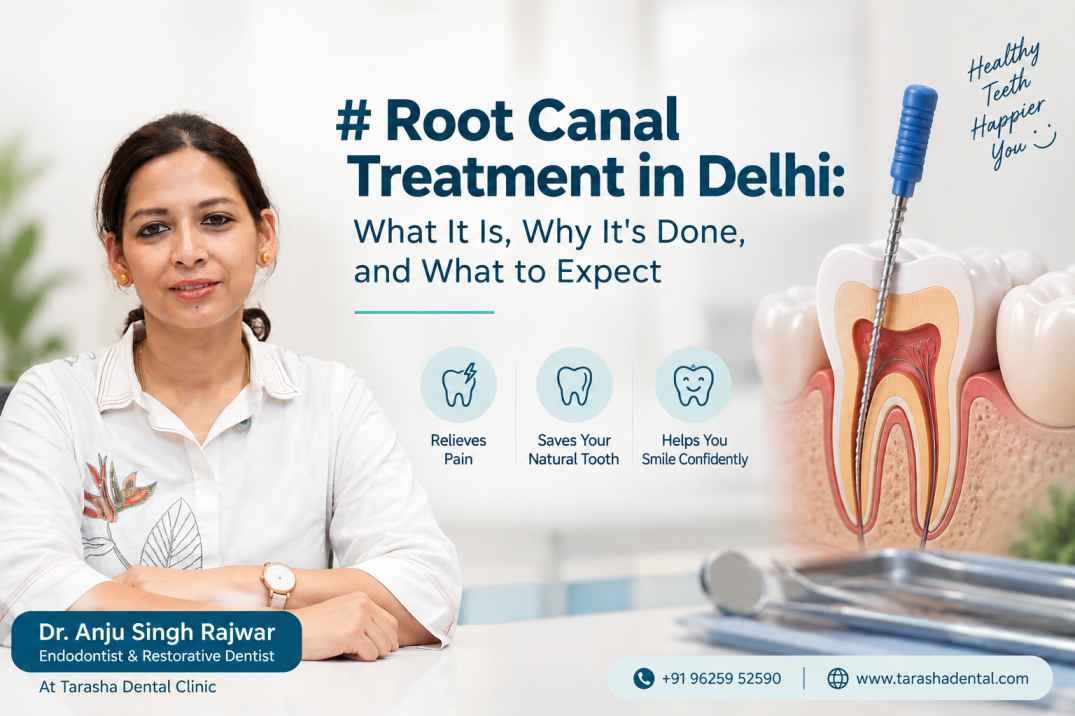
Reviewed by Dr. Anju Singh Rajwar — BDS, MDS, Senior Residency at AIIMS New Delhi · Founder & Director
Few dental procedures carry as much fear as the root canal. For many people, the phrase alone brings to mind severe pain and a long, uncomfortable appointment. In reality, modern root canal treatment in Delhi is a routine way to save a tooth that would otherwise be lost, and it is usually carried out to relieve pain rather than cause it.
At Tarasha Dental Clinic in Lajpat Nagar, New Delhi, root canal treatment is approached with careful diagnosis, appropriate anesthesia, and clear communication so that patients understand what is happening and why. This guide explains what a root canal is, the signs you may need one, what the procedure involves, and how to care for the tooth afterward.
Quick Answer
Root canal treatment (RCT) removes infected or inflamed tissue from inside a tooth, cleans and disinfects the inner canals, and seals them to prevent further infection. It is usually recommended when decay, a crack, or injury reaches the tooth’s pulp. Performed under local anesthesia, the procedure is generally comfortable, and a crown is often placed afterward to protect the treated tooth.
What Is Root Canal Treatment?
Inside every tooth is a soft inner tissue called the pulp, which contains nerves and blood vessels. When this pulp becomes infected or inflamed — usually because of deep decay, a crack, or trauma — it can cause pain and, if left untreated, may lead to an abscess or the loss of the tooth.
Root canal treatment involves removing the damaged pulp, cleaning and shaping the narrow canals inside the root, disinfecting the space, and then sealing it with a filling material. The goal is to preserve the natural tooth rather than remove it. Once treated, the tooth no longer has a living pulp, but it can continue to function normally with proper restoration.
Signs You May Need a Root Canal
The symptoms can vary, but some common signs include:
- Persistent or severe toothache, especially when chewing or applying pressure
- Prolonged sensitivity to hot or cold that lingers after the source is removed
- Swelling or tenderness in the nearby gum
- Darkening or discoloration of the tooth
- A recurring pimple-like bump on the gum
- Pain that disturbs sleep or does not settle with time
Some infected teeth cause little or no pain and are only detected during a dental examination or on an X-ray. This is one reason regular check-ups matter. If you have ongoing chewing pain that is difficult to locate, it may also be related to a cracked tooth, which a dentist can evaluate.
What Causes the Pulp to Get Infected?
The inner pulp can become damaged for several reasons, including:
- Deep tooth decay that reaches the pulp
- A cracked or fractured tooth
- Repeated dental procedures on the same tooth
- A large or failing filling
- Trauma or injury to the tooth, sometimes years earlier
Once bacteria reach the pulp, the body cannot clear the infection on its own because of the tooth’s sealed internal structure. This is why treatment is needed rather than waiting for it to heal.
Is Root Canal Treatment Painful?
This is the most common concern patients have, and the perception often comes from a time before modern anesthesia and techniques were widely available.
Today, root canal treatment is performed under appropriate local anesthesia, so the procedure itself is generally comfortable and comparable to having a filling placed. In most cases, the pain patients feel before treatment — caused by the infection — is far greater than anything experienced during it. Mild soreness for a few days afterward is normal and can usually be managed with prescribed or recommended medication.
Common Myths About Root Canal Treatment
Myth: A root canal is extremely painful
With modern anesthesia, the procedure is usually no more uncomfortable than a routine filling. It is designed to relieve the pain of an infected tooth.
Myth: It is better to just remove the tooth
Saving a natural tooth is often preferable when possible. A natural tooth maintains normal chewing and spacing, and removing it may require a replacement such as an implant or bridge.
Myth: Root canals cause illness
This claim is based on discredited, century-old research. There is no reliable scientific evidence linking properly performed root canal treatment to disease elsewhere in the body.
Myth: The benefits are only temporary
A well-treated and properly restored tooth can last for many years, often for life, with good oral hygiene and regular dental care.
The Root Canal Procedure, Step by Step
The exact process depends on the tooth and the extent of infection, but treatment generally follows these stages.
Step 1: Examination and Diagnosis
The dentist examines the tooth and takes an X-ray to assess the infection and the shape of the root canals. This helps plan the treatment.
Step 2: Anesthesia and Isolation
Local anesthesia is given to numb the area. The tooth is then isolated, often with a small protective sheet, to keep it clean and dry during treatment.
Step 3: Cleaning the Canals
An opening is made in the tooth, and the infected or inflamed pulp is carefully removed. The inner canals are cleaned, shaped, and disinfected.
Step 4: Filling and Sealing
The cleaned canals are filled with a biocompatible material and sealed to prevent bacteria from re-entering. A temporary or permanent filling closes the access opening.
Step 5: Final Restoration
Because a treated tooth can become more brittle, a dental crown is often recommended to protect it and restore full chewing strength.
Single-Sitting vs Multiple-Visit Root Canal
Some root canals can be completed in a single appointment, while others may need two or more visits. The right approach depends on the level of infection, the number and shape of the canals, and the individual tooth.
A single-sitting root canal can be convenient, but it is not suitable for every case. Teeth with significant infection or complex anatomy may benefit from additional visits to allow proper cleaning and healing. The decision should be based on clinical findings rather than convenience alone.
Why a Crown Is Often Needed After a Root Canal
After the pulp is removed, the tooth no longer receives its internal blood supply and can become weaker over time. This makes it more prone to fracture, especially for back teeth that handle heavy chewing forces.
A crown covers and protects the treated tooth, helping distribute biting pressure and reducing the risk of it cracking. Whether a crown is needed, and what type, depends on how much natural tooth structure remains.
Root Canal vs Tooth Extraction
When a tooth is badly infected, patients often ask whether it is better to save it with a root canal or simply remove it.
Preserving a natural tooth is usually the preferred option when the tooth can be predictably restored, because it maintains normal function and spacing. Extraction may be necessary when the tooth is too damaged to save. In that case, a replacement such as a dental implant or bridge is generally recommended to avoid problems caused by the gap. For a single missing tooth, a single tooth implant is one option a dentist may discuss.
The best choice depends on the specific tooth, the surrounding bone and gums, and your overall oral health.
Root Canal Treatment for Children
Children can also need root canal treatment, usually a modified procedure suited to baby teeth or young developing teeth. Preserving a baby tooth until it is ready to fall out naturally helps maintain space for the permanent tooth and supports normal chewing and speech.
Specialised root canal treatment for children is carried out gently and with age-appropriate care. A pediatric evaluation can determine whether it is needed.
Recovery and Aftercare
Most people return to their normal routine soon after a root canal. Some tenderness around the tooth for a few days is common. To support healing:
- Avoid chewing on the treated tooth until the final restoration is placed
- Take any recommended or prescribed medication as advised
- Maintain gentle but thorough brushing and cleaning
- Attend follow-up appointments to complete the crown or restoration
- Contact your dentist if swelling or significant pain develops
Completing the final restoration promptly is important, as leaving a treated tooth without proper protection can increase the risk of fracture or re-infection.
How Much Does Root Canal Treatment Cost in Delhi?
There is no single fixed price, because the cost depends on several factors:
- Which tooth is involved (front teeth usually have fewer canals than molars)
- The number and complexity of the root canals
- The extent of infection
- Whether it is a first-time treatment or a re-treatment
- The type of final restoration, such as a crown
- Any additional procedures required
A reliable dental clinic should examine the tooth first and then explain what the treatment includes before starting. At Tarasha Dental Clinic, treatment options and costs are discussed clearly so you can make an informed decision.
How to Reduce the Risk of Needing a Root Canal
Not every case can be prevented, but good habits lower the risk:
- Brush twice daily and clean between your teeth
- Limit frequent sugary foods and drinks
- Treat cavities early before they reach the pulp
- Wear a mouthguard during contact sports
- Avoid biting very hard objects that can crack teeth
- Attend regular dental check-ups
When Should You See a Dentist?
You should book an examination if you have:
- A persistent or severe toothache
- Lingering sensitivity to hot or cold
- Gum swelling or a bump near a tooth
- Pain when biting or chewing
- A discolored tooth after injury
Early evaluation gives the best chance of saving the tooth and can prevent the infection from spreading.
Root Canal Treatment at Tarasha Dental Clinic
At our dental clinic in Lajpat Nagar, patients with tooth pain receive a careful evaluation to identify the cause and the most suitable treatment. Where a root canal is needed, it is carried out with appropriate anesthesia and a focus on comfort, supported by AIIMS-trained dentists.
If you are experiencing tooth pain or sensitivity, an examination can help determine whether root canal treatment is required and what your options are.
📍 Tarasha Dental Clinic, Shop No. 1, 2 & 3, D-177, Opp. Railway Crossing, Block C, Lajpat Nagar I, New Delhi 110024
📞 011 7967 7314 | 💬 WhatsApp +91 96259 52590
🕒 Open Mon–Sun, 10:30 am – 8:00 pm
Book a consultation on WhatsApp →
Frequently Asked Questions
1. How long does a root canal take?
A single visit often takes around 30 to 90 minutes depending on the tooth, though some cases need more than one appointment. Molars with multiple canals usually take longer than front teeth.
2. Is a root canal painful?
The procedure is performed under local anesthesia and is generally comfortable. It is intended to relieve the pain caused by an infected tooth. Mild soreness afterward is normal for a few days.
3. Do I always need a crown after a root canal?
Not always, but a crown is commonly recommended for back teeth and heavily damaged teeth to protect against fracture. Your dentist will advise based on how much tooth structure remains.
4. How long will a root-canal-treated tooth last?
With proper restoration, good oral hygiene, and regular dental care, a treated tooth can last many years and often for life.
5. Can a tooth needing a root canal be treated with a filling instead?
No. Once the pulp is infected or inflamed, a filling alone cannot resolve it. Root canal treatment is needed to remove the infection and save the tooth.
6. What happens if I delay treatment?
Delaying can allow the infection to spread, leading to an abscess, increased pain, and a higher chance of losing the tooth. Early treatment gives the best outcome.