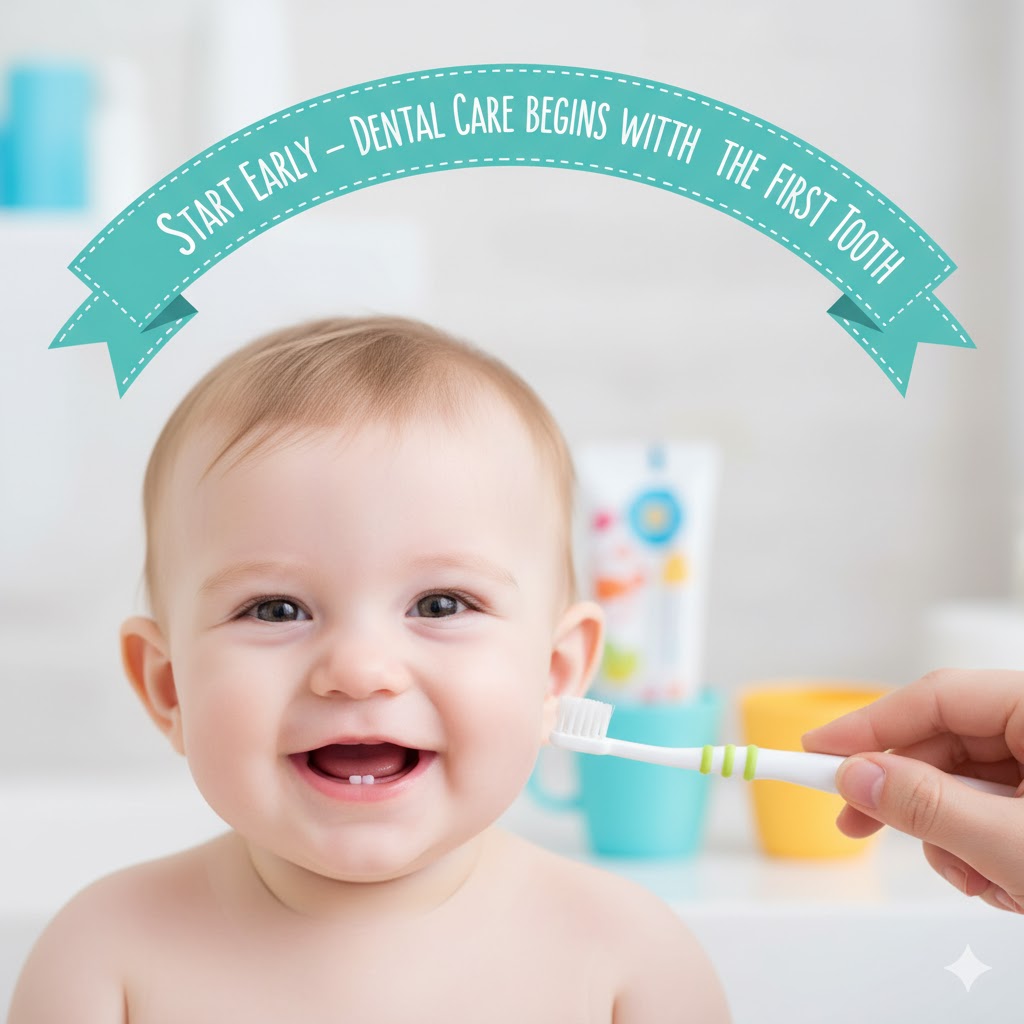
Why Milk Teeth Are More Important
Than You Think
A trusted guide for parents — from the pediatric dental experts at Tarasha Dental Clinic, Lajpat Nagar, South Delhi
🚨 Dental emergency? Child in pain? Don't wait.
📞 Call Now💛 That First Little Tooth
The moment your baby's first tooth peeks through — you know it. You feel it. That tiny, pearly little miracle that makes your heart melt and your phone camera go to overdrive. You save the photos. You call the grandparents. You celebrate.
But then, somewhere along the way, most parents stop thinking about it. After all… these teeth will fall out, right? They're just milk teeth.
If you've ever thought that — you're not alone. This is perhaps the most common and most damaging belief that parents in South Delhi, Lajpat Nagar, and across India carry about their children's dental health.
At Tarasha Dental Clinic, an initiative by AIIMS Alumni in Lajpat Nagar, South Delhi, we see the consequences of this belief every single day. Children walking in with preventable pain. Parents heartbroken, wondering, "Why didn't anyone tell me this earlier?"
So today, we're telling you. Because you deserve the truth — and so does your child's smile.
🦷 What Are Milk Teeth?
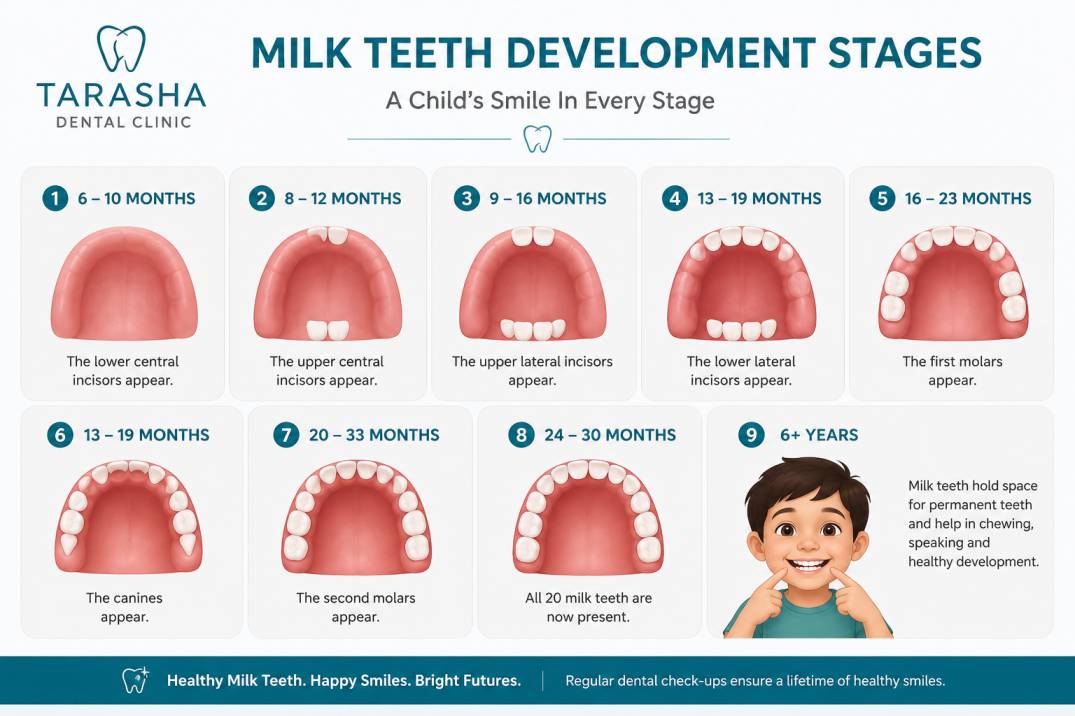
Milk teeth — also called primary teeth, baby teeth, or deciduous teeth — are the first set of teeth that appear in your child's mouth. They begin forming while your baby is still in the womb and typically start erupting around 6 months of age.
How Do Milk Teeth Develop?
By the time your child is around 2.5 to 3 years old, they will have a full set of 20 primary teeth — 10 on top and 10 on the bottom. These include incisors (front cutting teeth), canines (the pointed ones), and molars (wide, flat chewing teeth at the back).
- 6–10 months: Lower central incisors appear first
- 8–12 months: Upper central incisors follow
- 16–22 months: Canine teeth begin to appear
- 25–33 months: Second molars complete the set
- 6–12 years: Gradual replacement by permanent teeth
These milk teeth will serve your child for anywhere between 6 and 12 years. That's not temporary. That's a decade of your child's life depending on these teeth to function well.
⭐ Why Milk Teeth Matter — More Than You Know
Here's what changes when parents truly understand this: they stop treating their child's dental health as something that can wait.
1. They Enable Proper Nutrition & Healthy Eating
Think about what your 3-year-old eats — fruits, vegetables, rotis, dal, rice, snacks. Every single bite requires functional teeth. When milk teeth are decayed or missing, chewing becomes painful. Children start avoiding nutritious foods and prefer soft, sugary alternatives — creating a cycle of poor nutrition and more decay.
2. They Are Essential for Speech Development
Your child learns to form sounds, words, and language largely by positioning their tongue against their teeth. Sounds like "th", "f", "v", "s", and "z" all depend on proper tooth placement. Missing or damaged front teeth can lead to speech delays or lisping that may require speech therapy later.
3. They Hold Space for Permanent Teeth
This is the most misunderstood role of milk teeth. They act as natural space-holders in your child's jaw — keeping the space open and correctly positioned for the permanent teeth waiting below. When a milk tooth is lost too early, neighbouring teeth drift into the gap. The permanent tooth then comes in crooked, misaligned, or impacted — leading to expensive orthodontic treatment that could have been avoided.
4. They Support Jaw & Facial Development
Healthy milk teeth stimulate the jawbone through the natural forces of chewing. This is critical for the proper growth and shape of your child's jaw and face. Loss of milk teeth prematurely can affect facial structure and symmetry — sometimes permanently.
5. They Build Healthy Dental Habits for Life
Children who experience untreated pain early develop dental fear that follows them into adulthood. Children with positive early dental visits grow up unafraid — and that makes all the difference.
6. They Protect Your Child's Self-Confidence
Children with visibly decayed or missing front teeth often become targets of teasing. This affects their self-esteem, their willingness to smile, and their ability to engage confidently with friends and teachers. A healthy smile in childhood is more than dental health — it's mental wellbeing.
Tarasha Dental Clinic — An Initiative by AIIMS Alumni — brings the clinical precision of India's premier medical institution to Lajpat Nagar, South Delhi. Dr. Anju Singh Rajwar (BDS, MDS, Ex-AIIMS Delhi) has helped hundreds of families protect their children's smiles with compassionate, world-class care.
Learn more about Dr. Anju Singh Rajwar →
❌ Common Myths Parents Believe About Milk Teeth
In our clinic in Lajpat Nagar, South Delhi, we hear these beliefs from parents almost every week. Let's bust them — with facts.
"Milk teeth will fall out anyway, so why treat them?"
Milk teeth remain until age 10–12. Years of untreated pain and infection can occur in that time.
Untreated decay spreads rapidly. An infected milk tooth can damage the permanent tooth forming beneath it — before it has even emerged. Early treatment is always simpler and far less costly.
"My child doesn't complain of pain, so teeth must be fine."
Children adapt remarkably to pain. By the time they complain, decay is often already quite advanced.
Regular dental check-ups every 6 months allow a trained pediatric dentist to detect decay in its early, painless stages — before it becomes an expensive, distressing problem.
"A child is too young for the dentist — wait until older."
Many parents wait until age 4 or 5. By then, significant preventable damage may already have occurred.
The AAPD recommends the first dental visit by the child's first birthday. Early visits are gentle, educational, and habit-building — not scary at all.
"Only sweets cause cavities."
Biscuits, roti, fruit juice, and milk at night can all cause decay if teeth are not cleaned properly. It's the frequency of sugar exposure and quality of brushing that matters most.
⚠️ What Happens When Milk Teeth Are Ignored
The consequences of neglected milk teeth go far beyond a toothache. Here's what we see at our pediatric dental clinic in South Delhi regularly:
Untreated cavities become deep abscesses. Children suffer unnecessary pain disrupting sleep, eating, and concentration in school.
Early tooth loss causes neighbouring teeth to drift, leading to crowded, misaligned permanent teeth requiring costly orthodontic treatment.
Missing or damaged front teeth cause lisping or difficulty pronouncing sounds — impacting learning and social confidence.
Children in pain avoid chewing and gravitate toward soft, sugary foods — worsening decay while depriving their bodies of essential nutrients.
Infection from a decayed milk tooth can spread to the permanent tooth bud underneath — staining or damaging it before it even erupts.
Prevention and early treatment are always a fraction of the cost of treating advanced decay, abscesses, or orthodontic corrections later.
⚠️ A critical fact for parents in South Delhi & Lajpat Nagar: India has one of the highest rates of Early Childhood Caries (ECC) globally. Studies suggest over 50–60% of Indian children aged 2–5 show signs of dental decay. Yet most of this is entirely preventable with the right habits and timely professional care.
📅 When Should Your Child Visit a Dentist?
The answer often surprises parents. According to international pediatric dental guidelines — and the advice of Dr. Anju Singh Rajwar at our Lajpat Nagar clinic — the timeline looks like this:
First dental visit — a gentle introduction. The dentist checks gum health, discusses feeding habits, and counsels parents on hygiene. No drills, no fear. Just care.
Six-monthly check-ups. Fluoride application if recommended. Parent education on brushing technique, diet habits, and preventing baby bottle tooth decay.
Regular monitoring of all 20 milk teeth. Sealants may be applied to protect vulnerable molar surfaces. Any cavities treated promptly and gently.
Transition period. First permanent molars appear. Orthodontic assessment begins if needed. Continued six-monthly monitoring is essential.
Tooth pain, swelling, trauma, or knocked-out teeth — don't wait. Contact Tarasha Dental Clinic immediately for same-day pediatric dental care.

Image: Child's first dental visit
[Replace with clinic photo]
🚨 Signs Your Child Needs Dental Care Now
Do not wait for the next scheduled visit if you notice any of the following. These are red flags requiring prompt attention from a pediatric dentist in South Delhi:
- 🔴White, brown, or black spots on teeth — even a small spot can indicate early decay that needs treatment before it spreads.
- 🔴Your child complains of toothache or sensitivity — to hot, cold, or sweet foods. Pain is never normal.
- 🔴Swelling on the gums, face, or jaw — this can indicate an abscess which needs immediate dental care and possible antibiotics.
- 🔴A tooth knocked out or broken — trauma to milk teeth requires assessment as damage to the permanent tooth below may have occurred.
- 🔴Your child refuses to eat or chew on one side — a subtle sign of dental pain that children often cannot articulate.
- 🔴Prolonged thumb-sucking or pacifier use beyond age 3 — can cause dental and jaw development issues if left unaddressed.
- 🔴No dental visit in over 6 months — regular prevention is always better than emergency treatment.
Make dental hygiene fun! Let your child choose their toothbrush, use a flavoured fluoride toothpaste they enjoy, and brush together as a family. The habits you build now protect their smile for a lifetime.
👩⚕️ Expert Advice from Dr. Anju Singh Rajwar
We asked our lead pediatric dental specialist what she wishes every parent in Lajpat Nagar and South Delhi knew about their child's milk teeth:
"In my years of practice, both at AIIMS and now at Tarasha Dental Clinic, the most heartbreaking cases I see are children suffering from advanced decay that should have — and could have — been prevented so easily. A milk tooth is not a disposable tooth. It is a living, functional, vital part of your child's body.
Every parent who says 'it will fall out anyway' is, unknowingly, potentially setting their child up for years of pain, crooked adult teeth, speech difficulties, and a fear of dentists that may last their entire life.
My message to every parent in South Delhi: bring your child in early. Let us show you how simple and joyful dental care can be when we start right. The best time to act was yesterday. The second-best time is today."

Tarasha Dental Clinic, Lajpat Nagar, South Delhi
Dr. Anju's 7 Golden Rules for Milk Teeth Care
- ✅Clean gums from birth — wipe your newborn's gums with a clean, damp cloth after every feed, even before teeth appear.
- ✅Start brushing with the first tooth — use a soft-bristle infant brush and a grain-of-rice amount of fluoride toothpaste.
- ✅Never put your child to bed with a milk bottle — one of the most common causes of Early Childhood Caries (baby bottle tooth decay).
- ✅Limit between-meal sugar exposure — it's not just how much sugar, but how frequently teeth are exposed to it.
- ✅First dental visit by age 1 — don't wait for a problem. Come in for a wellness check and build a positive relationship with dental care early.
- ✅Visit every 6 months — regular check-ups catch problems when they are small, painless, and inexpensive to treat.
- ✅Make dental care a family value — children who see parents prioritising dental health grow up doing the same.
💬 What Parents Are Saying
Families from across Lajpat Nagar, South Delhi, and near AIIMS trust Tarasha Dental Clinic for their children's dental care.
"My daughter was only 2 when I brought her in — Dr. Anju was absolutely wonderful with her. She made the experience so gentle and positive. My daughter actually looks forward to her dental visits now!"
"Dr. Anju found early decay we had no idea about and treated it before it became a problem. Being an AIIMS alumna, her expertise is exceptional. Best pediatric dentist in South Delhi, no doubt."
"I was one of those parents who thought 'it's just a milk tooth.' Dr. Anju patiently explained everything. That conversation changed our entire approach to dental health. Thank you, Tarasha Dental!"
"Very close to AIIMS, highly professional, extremely gentle with children. My twins adore Dr. Anju! If you're looking for a pediatric dentist near AIIMS or in South Delhi, this is the place."
❓ Frequently Asked Questions
Questions parents at our Lajpat Nagar pediatric dental clinic ask us the most:
By your child's first birthday, or within 6 months of the first milk tooth appearing — whichever comes first. This first visit is calm, educational, and pressure-free. Dr. Anju will check your child's gum and tooth health and help build a positive relationship with dental care from the very start.
Milk teeth are critical for chewing and nutrition, clear speech development, jaw bone growth, and most importantly — holding space for permanent teeth. Early loss causes neighbouring teeth to shift, leaving no room for permanent teeth to erupt correctly.
Absolutely, yes. Untreated infection in a milk tooth can spread to the permanent tooth bud forming just beneath it — potentially causing discolouration or structural damage to the adult tooth before it has even erupted.
Tarasha Dental Clinic is located in Lajpat Nagar, South Delhi — easily accessible from AIIMS, Defence Colony, and Greater Kailash. Book by messaging on WhatsApp at +91-9625952590 or visiting tarashadental.com.
The most important steps: clean gums from birth; start brushing with the first tooth using fluoride toothpaste; avoid bedtime bottles with milk or juice; limit between-meal snacks; and schedule six-monthly dental check-ups from age 1.
Tarasha Dental Clinic is an initiative by AIIMS Alumni, led by Dr. Anju Singh Rajwar (BDS, MDS, Ex-AIIMS Delhi) — a pediatric dental specialist with AIIMS-level training. We combine clinical excellence with a warm, child-friendly environment designed to make dental visits stress-free and even enjoyable for children.

About the Author
Dr. Anju Singh Rajwar holds a BDS and MDS and completed her training at AIIMS Delhi. She is the lead pediatric dental specialist at Tarasha Dental Clinic, Lajpat Nagar, South Delhi — an initiative by AIIMS Alumni. Passionate about preventive pediatric dentistry, parental education, and building positive dental experiences for children from an early age.
Read full profile at tarashadental.com →