
Reviewed by Dr. Anju Singh Rajwar — BDS, MDS, Senior Residency at AIIMS New Delhi · Founder & Director
Losing a single tooth might seem like a minor issue, especially if it is not visible when you smile. But even one missing tooth can affect chewing, speech, and the health of the surrounding teeth over time. A single tooth implant in Delhi offers a stable, natural-looking way to fill that gap without altering the healthy teeth on either side.
At Tarasha Dental Clinic in Lajpat Nagar, New Delhi, single tooth implant treatment is planned around your individual dental condition, bone health, and goals. This guide explains what a single tooth implant is, how it compares with a bridge, what the procedure involves, and what to expect in terms of recovery and cost.
Quick Answer
A single tooth implant replaces one missing tooth using a small biocompatible fixture placed in the jawbone, an abutment, and a crown on top. Unlike a bridge, it does not rely on trimming the neighbouring teeth for support. At Tarasha Dental, Lajpat Nagar, it is planned case-by-case by AIIMS-trained specialists, and your suitability, timeline and cost depend on bone health, gum condition, and the tooth location.
What Is a Single Tooth Implant?
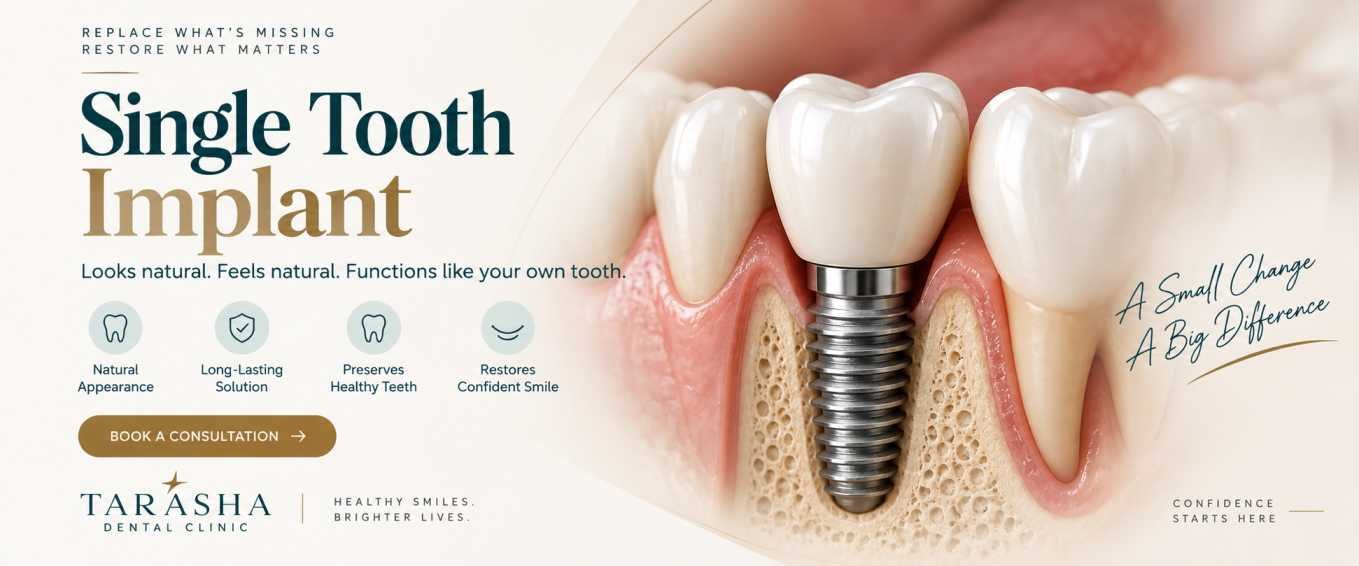
A single tooth implant is a tooth-replacement solution designed to replace one missing tooth, including its root. It has three parts:
- Implant: A small biocompatible post placed into the jawbone to act as an artificial root.
- Abutment: A connector that links the implant to the crown.
- Crown: The visible replacement tooth, shaped and shaded to match your natural teeth.
Once placed, the implant integrates with the surrounding bone over time in a process called osseointegration. This gives the replacement tooth a stable foundation that can look and function much like a natural tooth.
Why Replace a Single Missing Tooth?
A gap left by a missing tooth is not only a cosmetic concern. Over time, it can lead to several changes:
- Neighbouring teeth may gradually drift or tilt toward the gap
- The opposing tooth may over-erupt into the empty space
- The jawbone in that area may reduce in volume without a root to stimulate it
- Chewing efficiency and bite balance can be affected
- Cleaning can become harder if teeth shift, raising the risk of decay or gum problems
Replacing the tooth promptly helps maintain the alignment of surrounding teeth and supports long-term oral health.
Single Tooth Implant vs Dental Bridge
For a single missing tooth, a dental bridge is the traditional alternative to an implant. Both can restore the gap, but they work differently.
A bridge is supported by the two teeth on either side of the gap, which usually need to be reshaped to hold crowns. A single tooth implant, by contrast, stands on its own in the jawbone and does not require altering the adjacent healthy teeth. It also helps stimulate the underlying bone, which a bridge does not.
A bridge may be a suitable choice in some situations, such as when bone volume is limited or a faster solution is preferred. The right option depends on your oral health, bone condition, budget, and treatment goals, and is best decided after an examination.
Am I a Candidate for a Single Tooth Implant?
Many people with a single missing tooth are suitable candidates, but not everyone automatically qualifies. Suitability depends on factors such as:
- Adequate jawbone volume and density to support the implant
- Healthy gums free of active infection
- Good general health and controlled medical conditions
- Non-smoking or reduced smoking, which supports healing
- The location and spacing of the missing tooth
Where bone volume is insufficient, a procedure such as bone grafting may be recommended before or alongside the implant. If several teeth are missing, a different implant-based plan may be more appropriate. A consultation and imaging help determine the best approach.
The Single Tooth Implant Procedure, Step by Step
The process varies from patient to patient, but it generally follows these stages.
Step 1: Consultation and Diagnosis
The dentist examines the gap, surrounding teeth, gums, and bite, and takes imaging such as an X-ray or 3D scan to assess the available bone.
Step 2: Treatment Planning
A personalised plan is prepared, covering the implant position and size, the type of crown, and whether any additional procedure such as bone grafting is needed.
Step 3: Implant Placement
The implant is placed into the jawbone under appropriate local anesthesia. Most patients find this comfortable and comparable to a routine dental procedure.
Step 4: Healing and Integration
The implant is left to integrate with the bone over a period of weeks to months, depending on individual healing and bone quality. A temporary tooth may be provided in some cases.
Step 5: Crown Placement
Once the implant is stable, the abutment and custom crown are fitted, restoring the appearance and chewing function of the tooth.
How Long Does Treatment Take?
There is no single timeline for everyone. A straightforward case may be completed over a few months, largely because the implant needs time to integrate with the bone before the crown is placed. Cases that require bone grafting or additional healing may take longer. Your dentist can give a clearer estimate after assessing your specific situation.
Does It Hurt, and What Is Recovery Like?
Implant placement is carried out under local anesthesia, so the procedure itself is generally comfortable. Some swelling or soreness for a few days afterward is normal and can usually be managed with recommended medication and simple aftercare.
Most people return to their routine soon after the procedure. Following your dentist’s post-treatment instructions supports smooth healing.
Caring for Your Single Tooth Implant
An implant is not a natural tooth, but the surrounding gum and bone still need proper care to stay healthy. Good maintenance includes:
- Brushing twice daily and cleaning around the implant
- Cleaning between teeth as advised by your dentist
- Regular dental check-ups and professional cleaning
- Avoiding habits that can damage teeth, such as biting hard objects
- Managing any gum disease promptly
With good care, a well-placed implant can serve as a long-term replacement for the missing tooth.
Single Tooth Implant Cost in Delhi
The cost is not fixed, because it depends on several factors:
- The implant system and components used
- The type of crown
- The condition of the bone and whether grafting is needed
- Any tooth extraction required beforehand
- Diagnostic imaging and the complexity of the case
Because of this, a reliable clinic will examine the tooth and explain what the treatment includes before quoting a price. At Tarasha Dental Clinic, treatment options and costs are discussed clearly so you can make an informed choice.
When a Tooth Cannot Be Saved
Sometimes a damaged tooth can be preserved with root canal treatment, while in other cases the tooth is too damaged and needs to be removed. When a single tooth is lost or extracted, a single tooth implant is one of the options a dentist may discuss to replace it and restore normal function. You can also learn more about dental implants in general.
Why Choose Tarasha Dental Clinic?
Choosing where to have an implant placed should involve more than comparing prices. The team’s training, diagnostic tools, planning, implant systems, and follow-up all matter. At our dental clinic in Lajpat Nagar, patients have access to AIIMS-trained dental experts and personalised implant planning, with clear communication at each stage.
📍 Tarasha Dental Clinic, Shop No. 1, 2 & 3, D-177, Opp. Railway Crossing, Block C, Lajpat Nagar I, New Delhi 110024
📞 011 7967 7314 | 💬 WhatsApp +91 96259 52590
🕒 Open Mon–Sun, 10:30 am – 8:00 pm
Ask about a single tooth implant on WhatsApp →
Frequently Asked Questions
1. Is a single tooth implant better than a bridge?
Each has its place. An implant does not require reshaping the neighbouring teeth and helps stimulate the bone, while a bridge can suit certain situations such as limited bone. The right choice depends on your individual case and is best decided after an examination.
2. How long does a single tooth implant last?
With good oral hygiene, regular dental care, and proper maintenance, a well-placed implant can be a long-term replacement, often lasting many years.
3. Is the procedure painful?
Implant placement is performed under local anesthesia and is generally comfortable. Some soreness or swelling for a few days afterward is normal and manageable.
4. Will the implant look natural?
Yes. The crown is designed to match the shape, size, and shade of your surrounding teeth so it blends with your smile.
5. What if I don’t have enough bone?
A procedure such as bone grafting may be recommended to build up the area before or alongside the implant. Your dentist can assess this through clinical examination and imaging.
6. How soon after extraction can I get an implant?
It depends on the site and healing. In some cases an implant can be placed soon after extraction, while others need a healing period first. This is determined on an individual basis.