Dental Implant vs Bridge vs Denture: Which Tooth Replacement Is Right for You?
If you have a missing tooth — or several — you have three main ways to replace it: a dental implant, a dental bridge, or a denture. Each works differently, costs differently, and lasts differently. This guide explains all three in plain language so you can walk into your consultation already understanding your options.
There is no single “best” tooth replacement for everyone. A dental implant is usually the most durable and natural-feeling option and helps preserve jawbone, but it costs more and takes longer. A bridge is fixed and faster, but relies on the neighbouring teeth. A denture is the most affordable and least invasive, but is removable and less stable. The right choice depends on how many teeth are missing, your gum and bone health, your budget, and your preferences — confirmed after a clinical examination.
TL;DR — At a Glance
- Dental implant: fixed, longest-lasting, preserves bone, no damage to nearby teeth — highest upfront cost, needs surgery and healing time.
- Dental bridge: fixed and faster, good aesthetics — but requires filing down adjacent teeth and does not stop bone loss under the gap.
- Denture: most affordable, non-surgical, can replace many teeth at once — removable, less stable, may feel bulkier.
- Best for most single missing teeth: an implant, when bone and gums are healthy. Best on a tight budget or many missing teeth: a denture. Best when neighbouring teeth already need crowns: a bridge.
What Is a Dental Implant?
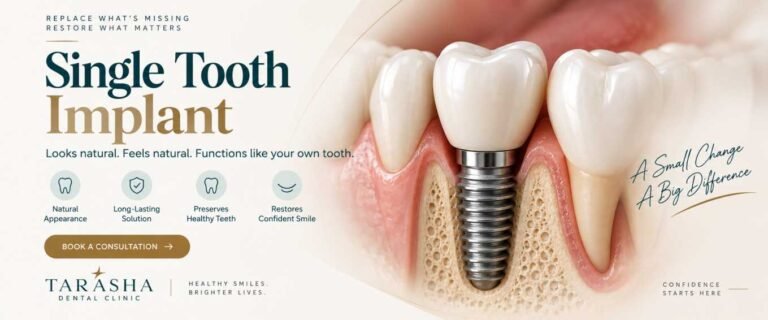
A dental implant is a small titanium post that is placed into the jawbone to act as an artificial tooth root. Once it fuses with the bone, it supports a custom crown — or, for several teeth, a bridge or full-arch set. Because the implant is anchored in bone, it is the only tooth replacement that functions like a natural root and helps maintain the jawbone beneath the gap.
Best suited to: replacing one or more missing teeth when the gums are healthy and there is enough bone (or bone can be built up). Learn more about dental implants in Lajpat Nagar and single-tooth implants.
Pros
- Fixed and stable — no removal for cleaning.
- Does not require filing down healthy neighbouring teeth.
- Stimulates and helps preserve the jawbone.
- Designed to last many years with good care.
Cons
- Highest upfront investment of the three.
- Involves minor surgery and a healing period of a few months.
- Requires adequate bone, or an additional procedure such as grafting.
What Is a Dental Bridge?
A dental bridge replaces a missing tooth by anchoring a false tooth (a “pontic”) to the natural teeth on either side of the gap. Those neighbouring teeth are prepared and crowned to carry the bridge. A bridge is fixed in place and does not come out, and it can usually be completed faster than an implant because there is no healing period for bone integration.
Best suited to: a gap where the adjacent teeth are strong — or already need crowns anyway. Explore dental crowns & bridges.
Pros
- Fixed, natural-looking, and usually faster than an implant.
- No surgery required.
- Often more affordable upfront than an implant.
Cons
- Healthy adjacent teeth must be filed down to support the bridge.
- Does not prevent bone loss in the area of the missing tooth.
- If a supporting tooth develops a problem, the whole bridge can be affected.
What Is a Denture?
A denture is a removable appliance that replaces missing teeth and the surrounding gum area. A partial denture replaces a few teeth, while a complete denture replaces a full arch. Dentures are the most affordable and least invasive way to replace several teeth at once, which keeps them a widely used option.
Best suited to: replacing many missing teeth affordably, or when surgery is not preferred. For more stability, dentures can also be anchored onto implants — see implant-supported overdentures.
Pros
- Most affordable option, especially for several missing teeth.
- Non-surgical and non-invasive.
- Can be made relatively quickly.
Cons
- Removable — taken out for cleaning, and can feel less stable than fixed options.
- May feel bulkier and can take time to get used to.
- Does not stop the gradual bone loss that follows tooth loss.
Dental Implant vs Bridge vs Denture: Comparison Table
| Feature | Dental Implant | Dental Bridge | Denture |
|---|---|---|---|
| Fixed or removable | Fixed | Fixed | Removable |
| Surgery needed | Yes (minor) | No | No |
| Affects nearby teeth | No | Yes (filed & crowned) | No |
| Preserves jawbone | Yes | No | No |
| Stability | Highest | High | Moderate |
| Typical treatment time | Longer (healing period) | Shorter | Shortest |
| Upfront cost | Highest | Moderate | Most affordable |
| Longevity with good care | Many years / decades | Several years to 10+ years | Replaced/relined over time |
| Best for | One or more teeth, healthy bone | A gap with strong adjacent teeth | Many teeth, tight budget |
This table is a general guide. The right option for your mouth is confirmed only after a clinical examination and, where needed, imaging — because factors like bone volume, gum health and bite all affect what will work best for you.
Not Sure Which Option Fits You?
The clearest way to compare implants, bridges and dentures is to have your mouth examined and your options explained in person. Book a consultation at Tarasha Dental Clinic in Lajpat Nagar.
Book a ConsultationOr call 011 7967 7314 · WhatsApp +91 96259 52590
How to Choose the Right Tooth Replacement
Instead of asking “which is best overall?”, it helps to ask “which is best for my situation?” These questions guide the decision:
How many teeth are missing?
For a single missing tooth with healthy neighbours, an implant is often ideal because it leaves those teeth untouched. For a few teeth in a row, an implant bridge or a conventional bridge may suit. For many or all teeth, dentures, implant-supported dentures, or full-arch implants are the usual options.
What is the condition of the nearby teeth?
If the teeth beside the gap are healthy, an implant avoids altering them. If those teeth already have large fillings or need crowns, a bridge can restore them and fill the gap together.
How is your gum and bone health?
Implants need healthy gums and adequate bone. Where bone is limited, grafting may make implants possible, or a bridge or denture may be recommended instead. This is confirmed with an examination and imaging.
What is your budget and timeline?
Dentures are usually the most budget-friendly and quickest. Bridges are a middle path. Implants are the largest upfront investment and take longer, but many patients consider them worthwhile for the long-term stability and bone preservation.
How Much Do Implants, Bridges and Dentures Cost in Delhi?
There is no single fixed price for any of these treatments, and a figure quoted online without an examination can be misleading. In general, dentures are the most affordable, bridges sit in the middle, and implants involve the highest upfront investment. Your actual cost depends on:
- How many teeth are being replaced.
- The materials and system used (crown, bridge or prosthesis type).
- Whether any additional procedures — such as bone grafting or extractions — are needed.
- The complexity of your case and the diagnostics involved.
At Tarasha Dental Clinic, you receive a clear, written, individualised estimate after a clinical assessment — not a one-size-fits-all number. We also welcome CGHS beneficiaries (cashless and reimbursement facilities) and NRI patients.
Frequently Asked Questions
Which is better: a dental implant, a bridge, or a denture?
There is no single best option for everyone. A dental implant is usually the most durable, stand-alone choice and helps preserve jawbone, but costs more and takes longer. A bridge is fixed and faster but relies on the neighbouring teeth. A denture is the most affordable and least invasive, but is removable and less stable. The right choice depends on how many teeth are missing, your gum and bone health, your budget, and your preferences — confirmed after a clinical examination.
Is a dental implant worth it compared to a bridge?
For many patients, yes. An implant replaces a single tooth without filing down the healthy teeth on either side, and it stimulates the jawbone like a natural root. A bridge is quicker and may cost less upfront, but it relies on the adjacent teeth and does not prevent bone loss under the gap. Which is better value for you depends on the condition of your neighbouring teeth and your long-term goals.
Are dentures cheaper than implants and bridges?
Generally, yes. Dentures are usually the most affordable way to replace missing teeth and do not require surgery. Implants typically involve the highest upfront investment, with bridges in between. However, cost is only one factor — stability, comfort, bone preservation and longevity differ too, and an individualised estimate is given after assessment.
Can I switch from dentures to implants later?
Often, yes. Many patients who find dentures loose or inconvenient later choose implants or implant-supported dentures for more stability. Whether this is possible depends on your jawbone and gum health at that time, which is assessed with an examination and imaging.
How long does each tooth replacement last?
With good care, dental implants are designed to last many years, often decades, though the crown may need maintenance over time. Dental bridges commonly last several years to over a decade depending on care and the supporting teeth. Dentures may need relining or replacement over the years as the mouth changes. Longevity in every case depends on oral hygiene, habits and regular professional maintenance.
Where can I get dental implants, bridges or dentures in Lajpat Nagar?
Tarasha Dental Clinic in Lajpat Nagar, South Delhi — an initiative by AIIMS alumni — offers dental implants, bridges and dentures, and helps patients compare the options after a clinical examination. You can call 011 7967 7314 or WhatsApp +91 96259 52590 to book a consultation.
Medical disclaimer: This article is for general educational purposes only and is not a substitute for professional advice. The right tooth replacement for you can only be confirmed by an in-person clinical assessment with a qualified dentist. For trusted patient information, see the NHS, the American Dental Association, or the Indian Dental Association.